
June 19, 2026: Heat, Horses, and Humbling Lessons
If you've spent any time in Texas lately, you've probably noticed it's hotter than a two-dollar pistol. The temperatures have been high, the humidity has been higher, and that makes this the perfect time to revisit something every horse owner should know: the Rule of 130.
Most horse owners have heard of it, but not everyone understands why it matters.
The Rule of 130 is simple. Add the temperature and humidity percentage together. If the total exceeds 130, conditions can become dangerous for horses, especially during exercise.
For example:
90° temperature + 50% humidity = 140
That's a problem.
Unlike people, horses rely heavily on sweating to regulate body temperature. When humidity rises, sweat cannot evaporate efficiently. The horse may continue sweating, but the cooling effect is greatly reduced. As body temperatures rise, the risks of heat stress, dehydration, heat exhaustion, and even heat stroke increase dramatically. Add in a condition called anhidrosis, where a horse's ability to sweat is reduced or absent altogether, and you've got a recipe for a potentially dangerous situation. That's why Texas horse owners pay so much attention to heat, humidity, airflow, water intake, and turnout schedules during the summer months.
That's one reason Equine Obsession changes turnout schedules during the summer. Horses spend their days in the barn and go out into pasture during the evening and overnight hours when temperatures are lower and the sun isn't relentlessly beating down on them.
Every stall is equipped with a fan. Horses have access to cool, fresh water. The barn is fitted with PortaCool units positioned to maximize airflow through the building. One sits near Bee's stall at the back entrance pulling cooler air into the barn while another helps push hot air out the opposite end.
Is it technically climate controlled? No.
Is it downright boujee compared to many barns? Absolutely.
The horses seem to agree.
Bee has become quite fond of her PortaCool. More than once this week, barn friends sent me photos of her standing at the front of her stall with her nose extended toward the cool airflow like she was at a luxury spa. Honestly, I can't blame her.
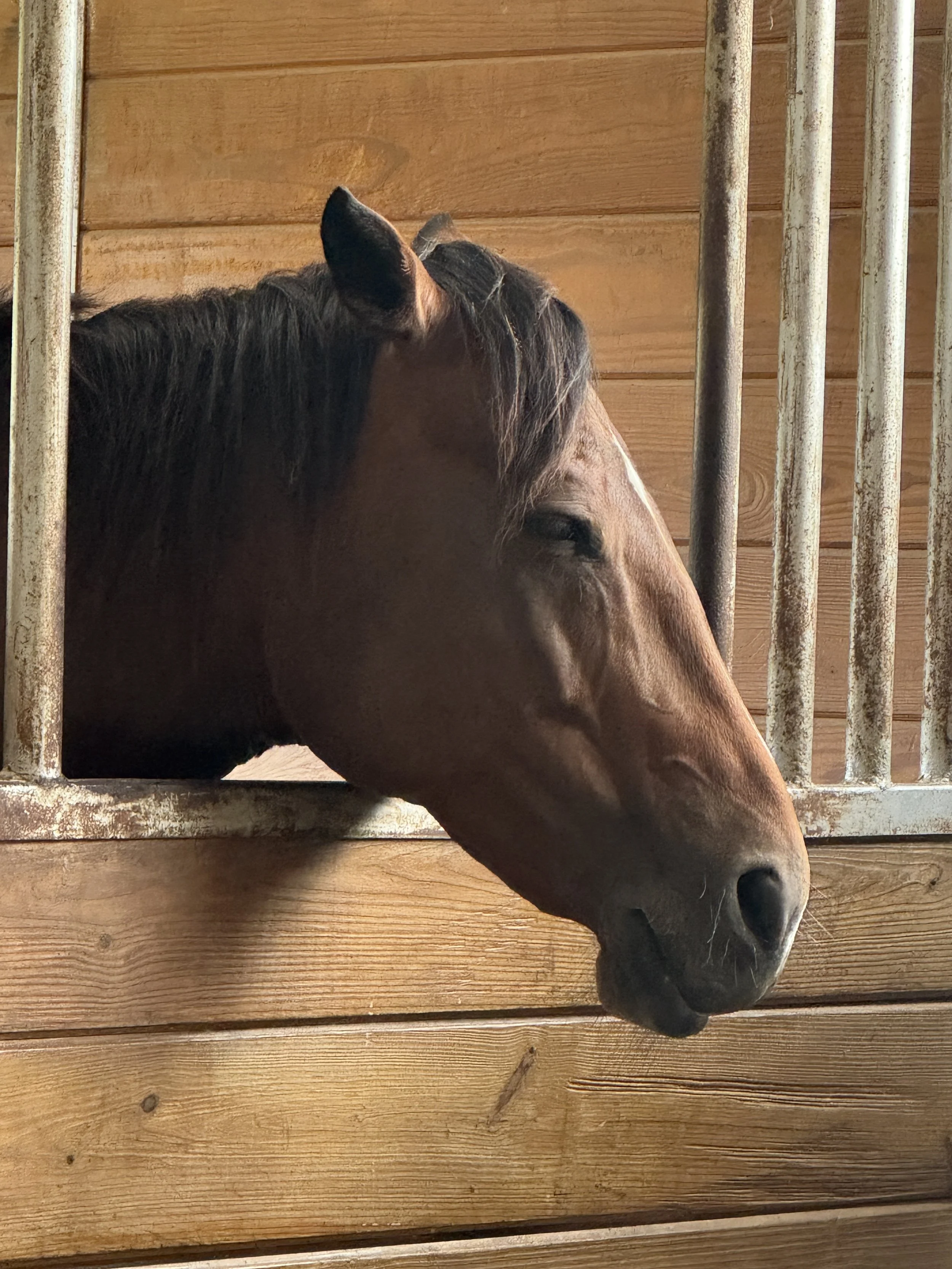
Is she sleeping?
One other thing happened this week that made me smile.
Connie sent me a photo of Bee stretched out asleep in her stall.
Now, if you're not a horse person, that may not sound like a big deal. Horses can sleep standing up thanks to a special locking mechanism in their legs. While they do need some deep REM sleep lying down, they generally only choose to fully stretch out and sleep when they feel safe, secure, and protected.
Considering Bee's anxious nature, seeing her completely relaxed and asleep in her stall felt like a pretty significant milestone.
I didn't witness it myself, but thankfully Connie provided photographic evidence because otherwise I might not have believed it. It was a nice reminder that while I've been worrying about whether Bee would adjust to stall life, she may have already decided she likes having her own little apartment.
Between the fans, fresh water, clean shavings, PortaCool breezes, and room service delivered twice daily, perhaps she's discovered that barn life isn't so bad after all.
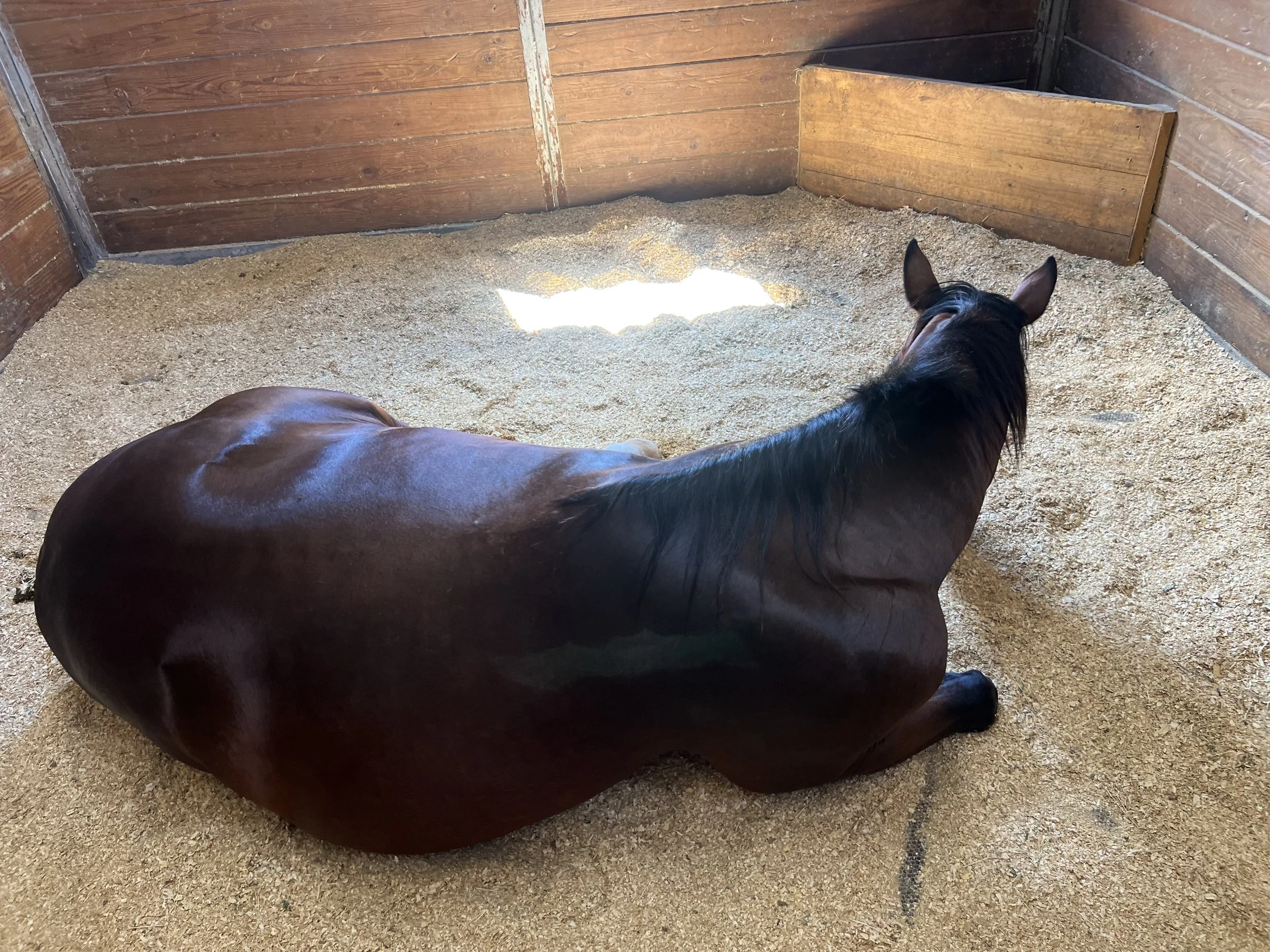
Sleeping Beauty
Speaking of Bee, I continue to get asked almost daily about the horse search.
The answer is simple.
We're looking, but we're not rushing.
Bee and I are both still taking lessons with Sarah every week. Regardless of when Bee eventually finds her next home, she will be in a far better place than she was back in February. Truthfully, so will I.
Bee has been riding wonderfully. The challenge isn't that she's a bad horse. Quite the opposite. The challenge is that I have reached a point where I can't learn something from Bee that she doesn't already know herself. Sarah keeps uncovering skills and buttons that were buried somewhere in Bee's training history. Sometimes it feels less like training and more like archaeology.
We've explored a potential trade with a lovely young woman in southern Illinois, but the logistics and expense simply don't make sense. Ideally, if Bee leaves, I'd like to find something local. Something I can ride multiple times, evaluate thoroughly, and have a complete pre-purchase exam performed before making a commitment.
There are many ways people find horses. Private sales. Trainers. Consignment programs. Auctions. Social Media. Even prison horse programs.
Many people don't realize that several correctional facilities operate horse training programs where inmates work with horses under professional supervision. These horses often receive extensive handling and training before being offered for sale. Like any horse purchase, success depends on evaluating the individual horse, its training, and whether it matches the rider.
That's really what this process is about.
Not finding any horse.
Finding the right horse.
A horse that matches my skill level today while helping me become a better horsewoman tomorrow.
Just as important is finding the right forever home for Bee.
We're not settling either direction. We believe God is leading the process, and until He makes the next step clear, I'm perfectly content to continue learning with the horse standing in front of me.
Which brings me to one of my favorite moments this week.
Sarah had previously asked me to keep Bee's work confined to the round pens and arenas. Given Bee's history of anxiety and spooking, it was good advice.
But occasionally I make poor decisions.
With a helmet firmly secured on my head and several trusted barn friends already riding nearby, I decided to walk Bee down the road toward an area on the property known as the Hayfield.
I fully expected to see signs of anxiety.
Instead, she calmly walked down the road like she'd been doing it her entire life. Head low, breathing calm and relaxed. No drama. No tension. No fireworks. Just a quiet, relaxed horse. (Who stole my horse?)
We made it to the entrance of the Hayfield before my riding companions turned back toward the barn, so Bee and I simply followed them home.
It wasn't a long ride.
It wasn't an exciting ride.
But it was a successful ride.
The kind of success that reminds you progress doesn't always arrive with fanfare.
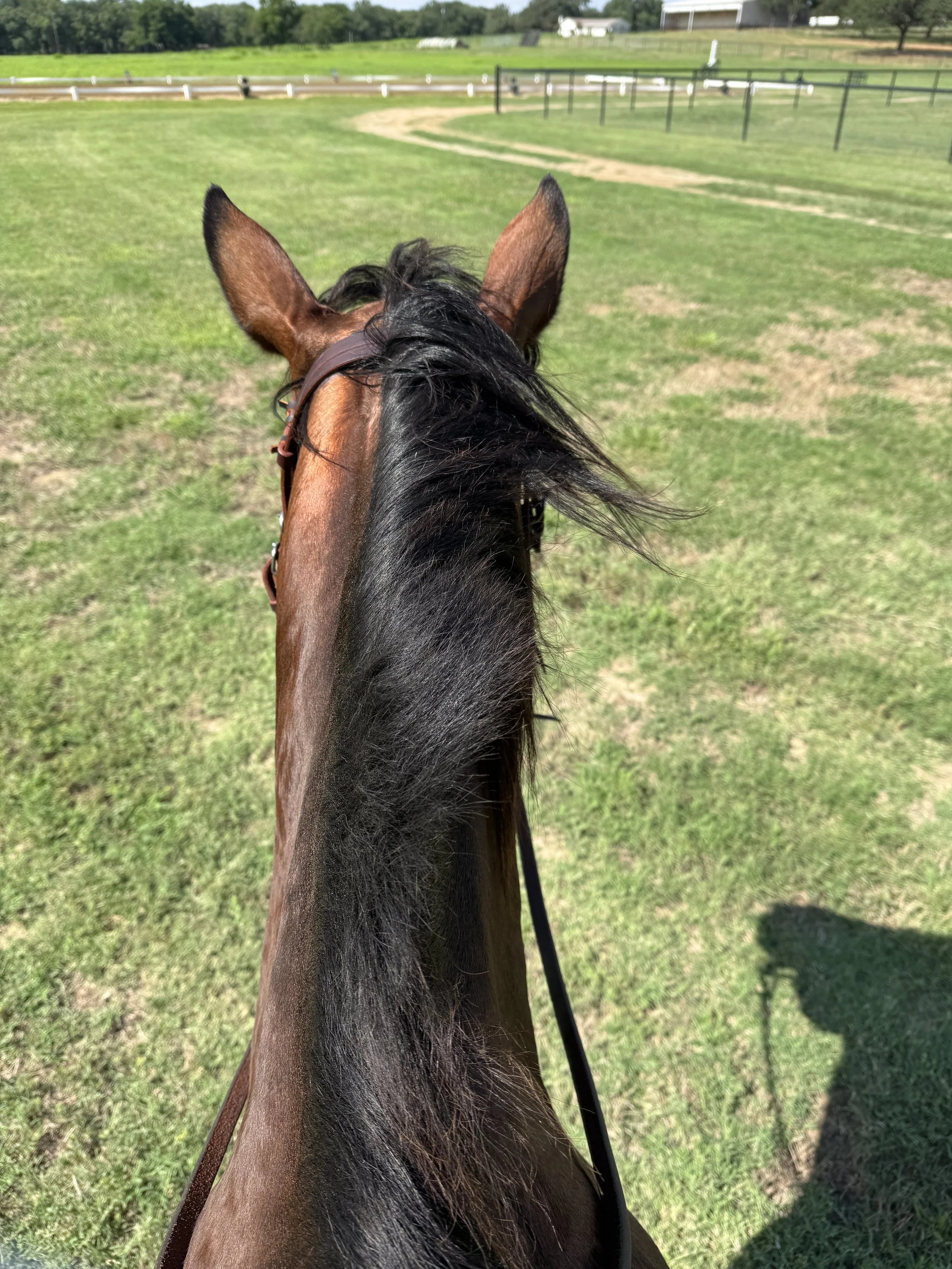
Chill girl(s). The black tips of her ears are my favorite.
Of course, success immediately made me overconfident.
I've since taken her back out several times and, yes, I confessed everything to Sarah.
Her response?
"She's your horse. Do what you want."
I suspect there was a little more meaning behind that statement than she let on. But she knows grace and is giving me some.
Bee has had one good spook since then, but she stayed with me and never attempted to leave the county. Her biggest issue lately has actually been walking faster than I want her to. We've spent plenty of time working on slowing her feet and keeping her focused.
Still, she's done remarkably well.
The biggest breakthrough of the week happened during Thursday's lesson.
Somewhere along the way, I finally started understanding split reins.
Apparently, there are advantages to reins that don't spend half their time tangled around your fingers.
You can ride one-handed. You can ride two-handed. You can use the tail end to reinforce a cue. And you can switch between those options in a matter of seconds.
More importantly, Sarah helped me identify a couple of mistakes I'd been making.
When steering, I tend to pull toward my pocket instead of using a gentle lifting motion. Sarah described it as lifting Bee's foot rather than dragging her face.
That visual finally clicked.
We also discovered that when asking Bee to slow down, my hands were positioned too narrowly. My overall motion was mostly correct, but my hands were too close together to create the effect I wanted through the bit.
We ride Bee in a twisted snaffle. It's one of the milder bits available because it has no shanks creating leverage and no curb adding additional pressure. That said, any bit can become uncomfortable in the wrong hands.
I can confidently report that Bee seems very appreciative of my newfound ability to pull on her mouth less.
Progress for both of us.
And that's really the theme of this week.
Progress.
Not perfection.
Not rushing.
Not forcing outcomes.
Just continuing to learn, continuing to improve, and trusting that the right horse, the right home, and the right next chapter will arrive exactly when they're supposed to.
Until then, Bee and I will keep showing up.