
June 26, 2026: New World Screwworm - What Every Horse Owner Needs to Know
⚠️ Content Warning: This article contains close-up educational images created by ChatGPT of New World Screwworm larvae and infected wounds. While the images may be unsettling, they are included for one reason: education. Recognizing the signs early can save the life of a horse, cow, sheep, goat, pet, or wildlife animal. Viewer discretion is advised. Viewer discretion is also advised to look for all the ChatGPT imaging errors, it’s a where’s waldo of fun.
If the photos in this article make your skin crawl, you're not alone! Mine too!
The first time I saw a picture of a New World Screwworm infestation, my scalp tingled and I immediately wanted to look away. But then I realized something important.
As horse owners, sometimes we don't have the luxury of looking away.
Knowing what something looks like could be the difference between catching it early or missing the signs until it's too late.
New World Screwworm isn't just another fly or another summertime nuisance. Unlike common maggots that feed on dead tissue, New World Screwworm larvae feed on living flesh. Left untreated, an infestation can rapidly destroy healthy tissue, cause severe pain, and even become fatal.
With recent concern surrounding the spread of New World Screwworm, especially across the southern United States, now is the perfect time for all of us to learn what it is, how to recognize it, and most importantly, how to prevent it.
What Is New World Screwworm?
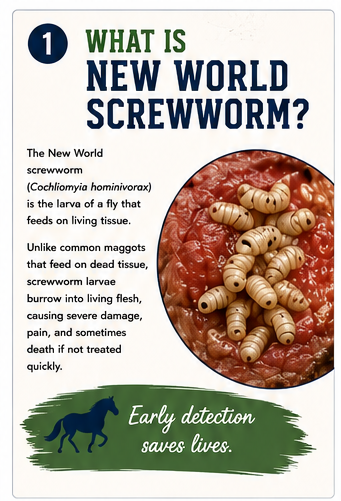
Despite its name, the screwworm isn't actually a worm.
It's the larval stage of the New World Screwworm fly (Cochliomyia hominivorax).
The name "screwworm" comes from the way the larvae burrow into living tissue with a screw-like motion as they feed.
Unlike ordinary maggots that help decompose dead animals, these larvae attack healthy, living tissue. That's what makes them so destructive.
Female flies are attracted to fresh wounds, even tiny ones that most of us wouldn't think twice about. Once eggs hatch, the larvae immediately begin feeding and enlarging the wound.
How Does It Happen?
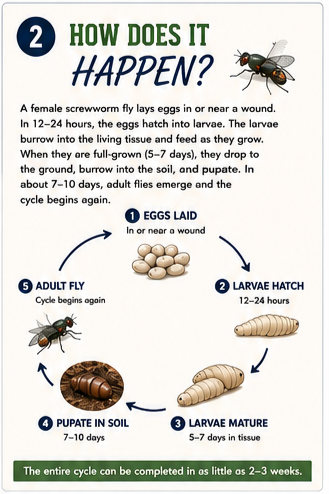
The entire life cycle is surprisingly fast.
An adult female fly finds an animal with a wound.
She lays hundreds of eggs around the edge of the wound.
Within about a day, the eggs hatch.
The larvae burrow into living tissue.
After several days of feeding, they drop to the ground.
They pupate in the soil before emerging as adult flies to repeat the cycle.
Under warm conditions, this entire process can occur in just a few weeks, allowing populations to grow rapidly.
How Horses Become Infected
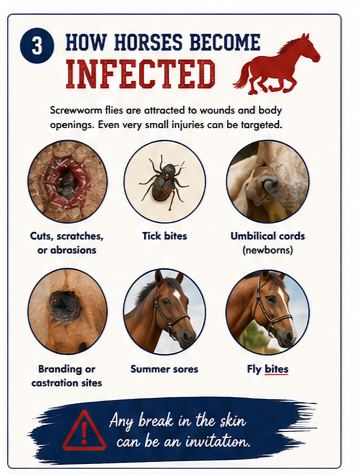
One of the scariest parts is that the wound doesn't have to be large.
Common entry points include:
• Small cuts or scrapes
• Tick bites
• Fly bites
• Summer sores
• Castration sites
• Branding sites
• Surgical incisions
• Umbilical cords in newborn foals
Essentially, any break in the skin can become an invitation if a screwworm fly finds it.
That's why daily inspections are so important during fly season.
Signs to Watch For
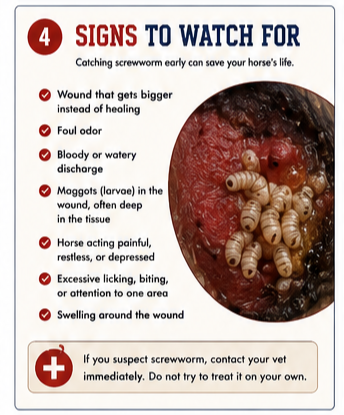
Early detection saves lives.
Watch for:
✔ A wound that keeps getting larger instead of healing
✔ Bloody or watery discharge
✔ A foul odor
✔ Visible larvae deep inside the wound
✔ Swelling around the area
✔ Horses repeatedly biting, licking, rubbing, or protecting one spot
✔ Depression, pain, or unwillingness to move
If you ever suspect a screwworm infestation, contact your veterinarian immediately. This is not something to "watch for another day."
Prevention Is Your Best Defense
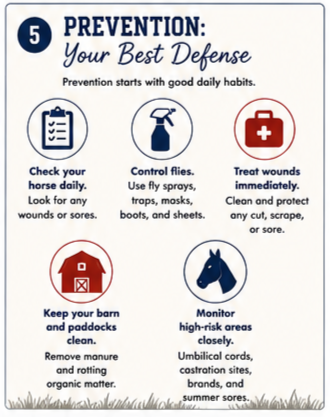
Fortunately, prevention is fairly straightforward.
Inspect your horse every day.
Treat even small wounds promptly.
Practice aggressive fly control.
Keep stalls, paddocks, and turnout areas as clean as possible.
Use fly sprays, fly masks, sheets, and boots when appropriate.
If your horse develops a wound, clean it, protect it, and continue monitoring it until it has completely healed.
An open wound is simply too inviting to ignore.
Why Texas Is Paying Attention
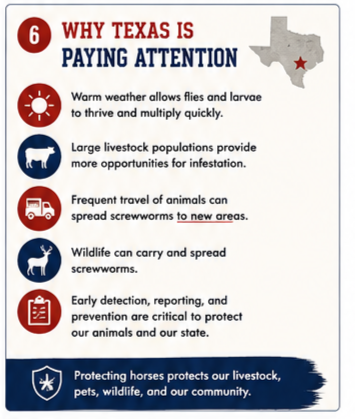
Texas has ideal conditions for flies.
Long summers.
Warm temperatures.
Large livestock populations.
Heavy animal movement.
Wildlife.
Because of these factors, early detection is critical.
Protecting horses also helps protect cattle, sheep, goats, wildlife, and neighboring farms.
One missed infestation has the potential to affect far more than a single animal.
Can We Just Deworm Our Way Out of This?
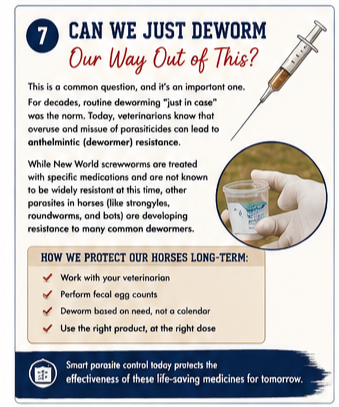
This is a question many people have asked.
The answer is...not exactly.
Veterinary medicine has changed dramatically over the past two decades.
Years ago, many horse owners routinely dewormed every six to eight weeks. Today, veterinarians often recommend targeted parasite control based on fecal egg counts and an individual horse's parasite load.
Why?
Because parasites adapt.
Repeated exposure to the same medications allows the strongest parasites to survive and reproduce, creating what veterinarians call anthelmintic resistance, or dewormer resistance.
While New World Screwworm itself is managed differently than common intestinal parasites, the lesson remains the same.
Responsible medication use helps preserve the effectiveness of the treatments we depend on.
It's one reason veterinarians encourage horse owners to work with them on an individualized parasite control program instead of simply following a calendar.
Why Non-Horse Owners Should Care
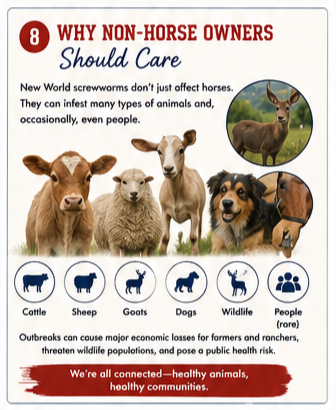
This isn't just a horse problem.
New World Screwworm can affect:
• Cattle
• Sheep
• Goats
• Dogs
• Wildlife
In rare cases, it can even affect people.
For ranchers, an infestation can lead to significant economic losses.
For wildlife, outbreaks can impact entire populations.
For pet owners, any untreated wound has the potential to attract flies.
Whether you own horses or not, keeping wounds clean and recognizing the signs benefits everyone.
Healthy animals help build healthy communities.
The Bigger Lesson
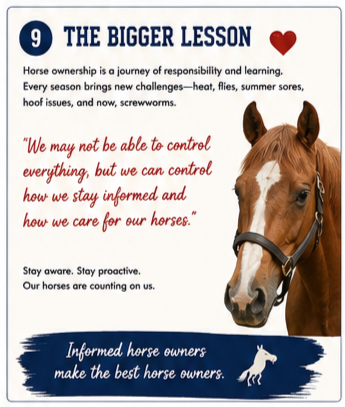
One thing I've learned since becoming a horse owner is that the learning never stops. Every season brings something different. Heat. Humidity. The Rule of 130. Summer sores. Fly control. Hoof care. Now, New World Screwworm.
Our horses rely on us to notice the small changes before they become big problems. That means asking questions. Learning from veterinarians (lucky for me I know a few). Paying attention. And sometimes reading articles with photos we'd really rather not see. Because staying informed is one of the greatest gifts we can give the animals that depend on us.
Hopefully you'll never encounter New World Screwworm firsthand. But if you do, you'll know exactly what you're looking at, and you'll know to call your veterinarian immediately.
Please pray that Bee and the other horses at EO remain safe from any infestations.
Sometimes knowledge isn't comfortable. But it is lifesaving. So yes, I’m checking Bee over daily. Fly spraying her daily. Any cuts or scrapes are getting Ivermectin directly on them followed by a skin barrier like Desitin, on repeat, until her skin is healed. Her summer sores (only one tiny one on her lip and I’m not even sure it counts, are getting Ivermectin daily as well).
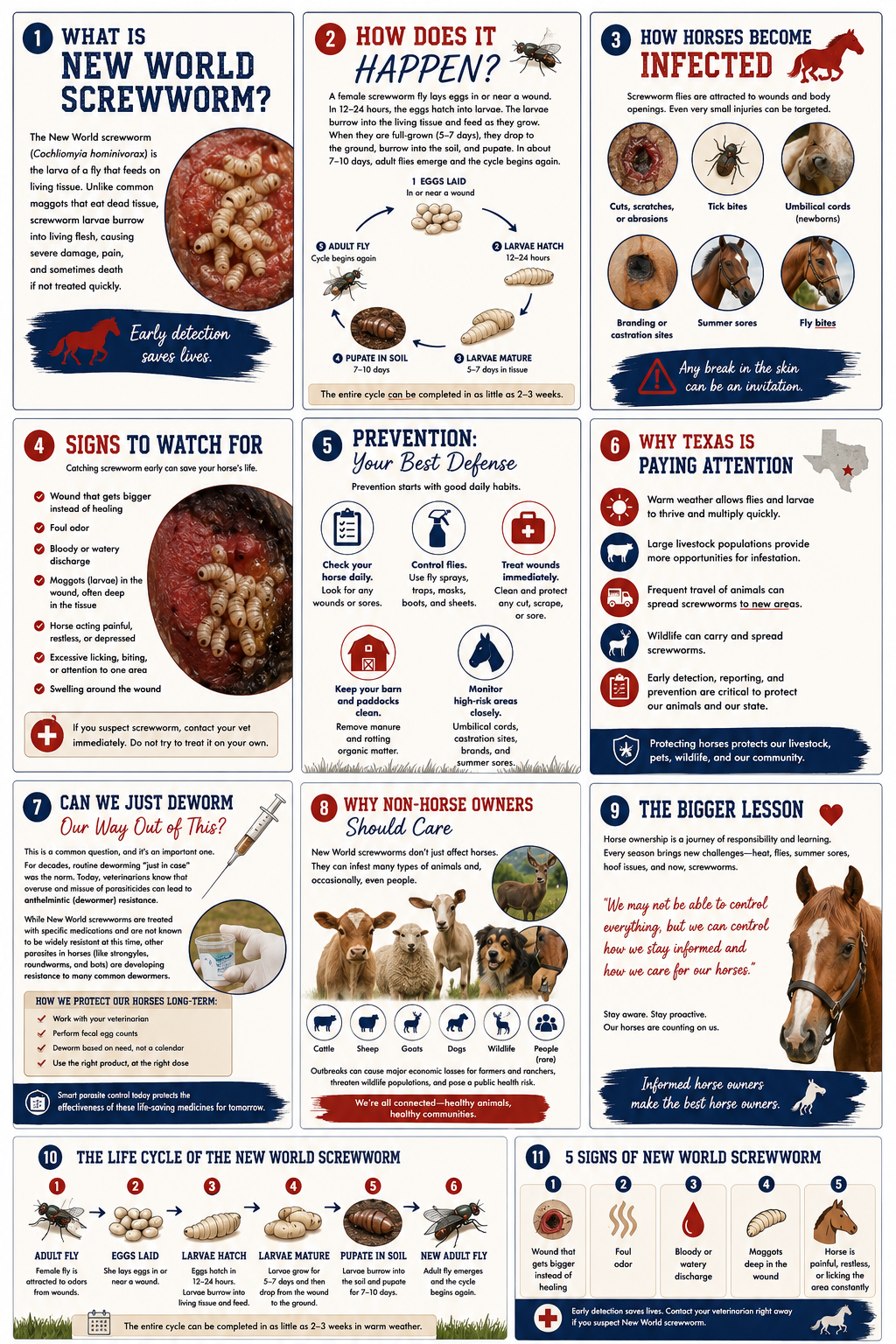
Downloadable 1-pager