
October 25, 2026: Horse Breathing, Tying Up & AI
After spending another week around horses, I've reached a conclusion: the more I learn about these animals, the more I realize how much I don't know.
This week brought lessons about horse anatomy, a serious muscle condition, artificial intelligence, and, unexpectedly, Bee's love life. Apparently, the mare pasture has more drama than a reality television show.
And somehow, Bee managed to turn all that education into a vacation from riding.
Bee's Love Life Gets Complicated
Apparently, Bee has decided it's time to reenter the dating scene.
Since taking her off the medication that suppressed her estrous cycles, we've noticed a new development. His name is Mickey, and he's a handsome Paint gelding who shares a fence line with the mare pasture.
Before stopping her medication, Bee barely gave Mickey the time of day. Now? Let's just say she's discovered the boy next door.
And she's not the only mare who's noticed him!
There's been quite a bit of mutual grooming over the fence, which is when horses use their teeth and lips to gently scratch and nibble one another. It's a normal social behavior that helps horses bond.
Under ordinary circumstances, I'd call it adorable.
Unfortunately, Mickey seems to have developed something of a fan club, and the ladies aren't always willing to share his attention.
Apparently, the mare pasture has turned into an episode of The Bachelor, complete with flirting, jealousy, and a little physical altercation.
For those unfamiliar with mare behavior, horses typically cycle during the longer daylight months, although some continue showing signs of estrus at other times of year. Estrus is the period when a mare is receptive to a stallion. Hormonal changes can influence how some mares interact with other horses, even geldings.
Of course, mutual grooming doesn't necessarily mean romance, and I can't say for certain that Bee's newfound interest in Mickey is entirely hormonal. But the timing certainly has me wondering!
And here's where the drama gets interesting.
Bee ended up with a pretty substantial bite on her back this week, right where her saddle sits.
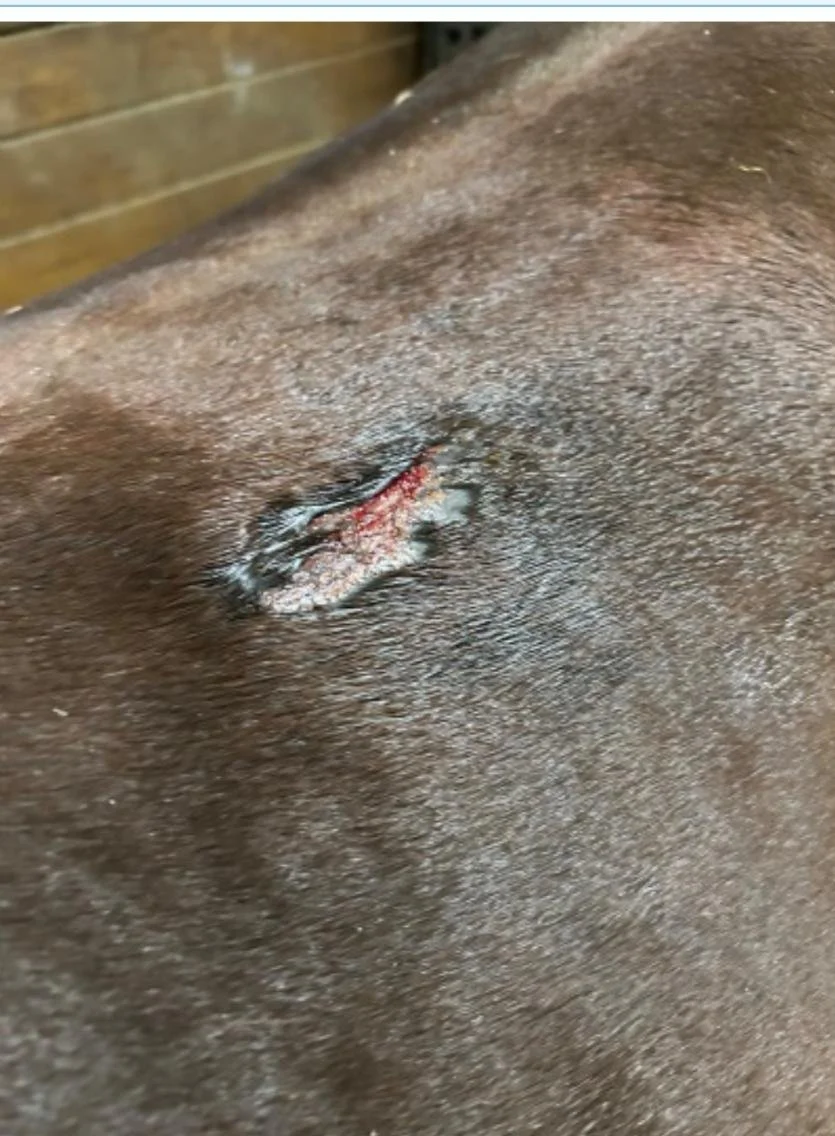
Was it Mickey? One of the other mares? A disagreement over who got the next grooming appointment?
We may never know. Apparently, nobody in the pasture is talking.
What I do know is that Bee is officially on a riding vacation until the bite heals. The last thing I want to do is put a saddle over a painful wound and make things worse.
Horse bites can cause more tissue damage beneath the skin than they initially appear to, so we're keeping an eye on it and will involve the veterinarian if there are signs of infection, significant swelling, worsening pain, or delayed healing.
This has also been a reminder that herd dynamics can change. Horses establish relationships, form friendships, compete for resources and attention, and occasionally settle their disagreements with teeth or hooves.
The combination of changing hormones, a handsome neighbor, and several opinionated mares might just be a recipe for drama.
So while I had planned to spend more time in the saddle this week, Bee apparently had other priorities.
New boyfriend. New enemies. New bite wound.
And here I thought taking her off her cycle medication might simplify things.
Mickey, if you're reading this, please stop encouraging the girls. Some of us would actually like to ride our horses!
Wait. Horses Can't Breathe Through Their Mouths?
Did you know horses can only breathe through their noses?
I didn't!
Unlike humans, who can switch between breathing through our noses and mouths, horses are what scientists call obligate nasal breathers.
This means their normal anatomy requires air to travel through their nostrils to reach their lungs.
The reason involves something called the soft palate, a flexible structure toward the back of the roof of the mouth. In horses, the soft palate forms a close seal with the structures around the larynx, directing airflow from the nasal passages toward the windpipe.
So when we're exercising and start breathing heavily through our mouths, our horses don't have that option.
Think about that the next time you watch a horse galloping across a pasture!
Those enormous, flaring nostrils aren't just for dramatic effect. They're essential to moving air in and out during exercise.
It also explains why respiratory problems can be particularly concerning in horses. They can't simply open their mouths and compensate for an obstructed nasal passage the way we might.
Now, horses certainly open their mouths to yawn, eat, play with their bits, and express their opinions. Bee has mastered several of those activities. But opening her mouth doesn't mean she's breathing through it.
I find that fascinating. But after several years of learning everything I can about Bee, this was somehow news to me!
What in the World Is "Tying Up"?
The second thing I learned this week was about a condition called tying up.
At first, I assumed it had something to do with a horse getting tangled in a lead rope.
Nope.
Tying up is the common name for a group of muscle problems, often involving exertional rhabdomyolysis. That's a medical term for muscle damage associated with exercise.
In simple terms, a horse's muscles become painful, stiff, and sometimes severely cramped. In more serious cases, muscle cells can actually break down.
The signs can include unusually stiff movement, excessive sweating, trembling muscles, rapid breathing, and reluctance to move. Some horses develop particularly painful, firm muscles over their hindquarters. Severe cases can produce dark-colored urine and damage the kidneys.
And here's something important: If a horse appears to be tying up, don't force it to keep walking to loosen the muscles. Stop exercise and call your veterinarian.
Apparently, the old idea of walking out a muscle cramp can make matters worse when muscle damage is occurring.
Tying up isn't always caused by the same thing. Sometimes it follows exercise that's too demanding for the horse's current fitness level. Other horses have underlying muscle disorders that make them susceptible to repeated episodes. Diet, training routines, and certain metabolic or genetic factors can also play a role.
Diagnosis may involve blood tests that measure muscle enzymes, which increase when muscle cells are damaged.
I was particularly interested in this because I'm always trying to better understand the difference between a horse being stiff, sore, tired, or genuinely uncomfortable.
With Bee, there's also the occasional challenge of determining whether she's physically uncomfortable or simply expressing a strong opinion about the day's agenda.
As I'm learning, those are not necessarily mutually exclusive!
Can Artificial Intelligence Tell Me if Bee Is Lame?
Now for the part of this week's education that really got my attention.
I was introduced to an app called RealHorse, which uses smartphone video and artificial intelligence to analyze how a horse moves.
I downloaded it using a 14-day free trial and couldn't wait to try it.
The idea is pretty fascinating. Rather than relying entirely on what we think we're seeing, the app analyzes movement patterns and looks for differences between the left and right sides of the horse.
Those differences are called asymmetries.
A horse that is lame is experiencing an abnormality in its gait, often associated with pain, although not every gait abnormality is caused by pain. And not every asymmetry means a horse is lame.
That's an important distinction.
If you've spent much time at a boarding barn, you've probably heard someone say, "I think my horse feels off today."
I've heard it countless times.
Sometimes a rider notices a shortened stride, an uneven rhythm, or something that simply doesn't feel quite right. Other times, several people watch the same horse trot and come away with different opinions.
Wouldn't it be wonderful to have an additional tool to help make those observations more objective?
That's what caught my interest.
Bee Becomes My Test Subject
The app required me to record Bee trotting in a circle in both directions, with a minimum of 30 strides each way.
So off we went.
Bee trotted to the left. Bee trotted to the right. I recorded the videos and submitted them for analysis.
And then I got my results.
RealHorse reported:
"Mild impact asymmetry of the left forelimb when comparing the circles."
Hmmm.
I understood most of those words individually. Together? I needed a little more education.
In everyday language, the app detected a small difference in Bee's movement associated with her left front leg when comparing the two directions.
Impact asymmetry generally refers to differences in movement around the part of a stride when the hoof lands and begins bearing weight. However, the exact meaning of this particular measurement depends on how RealHorse calculates and reports its results.
Fortunately, the app offered some interpretation:
"While slight asymmetries are observed, they fall within the range of normal variation. Consider periodic monitoring to ensure ongoing well-being and adjust workload or management as needed."
Well, that was encouraging!
It wasn't telling me Bee was lame. It was identifying a mild difference that the app considered within normal variation.
And that's where things get interesting.
Why Trotting in Circles Matters
Horses don't necessarily move identically when traveling left and right.
A circle changes the forces on their legs, and many horses naturally show some movement asymmetry depending on the direction they're traveling.
That means a slight difference doesn't automatically indicate an injury.
Researchers have studied RealHorse's video-analysis technology by comparing its measurements with sophisticated motion-capture systems. Published studies have found encouraging agreement in measuring certain aspects of equine movement.
That's impressive technology to have available on a phone!
But there's an important limitation: measuring asymmetry accurately is not the same as diagnosing the cause of that asymmetry.
An app can't examine Bee's joints, palpate her muscles, check her hooves, or determine whether she's experiencing pain. That's where a veterinarian comes in.
And if Bee were obviously lame, uncomfortable, or reluctant to move, I certainly wouldn't keep trotting her in circles just to collect more video.
What I Really Like About This Technology
I love tools that help take some of the guesswork out of horse ownership.
There are so many things we're constantly evaluating. Is the saddle fitting correctly? Are the feet balanced? Is that stiffness normal? Is my horse having an off day, or is something actually wrong?
The more objective information I can collect, the better questions I can ask.
What excites me most about RealHorse isn't the idea of replacing my veterinarian. It's the possibility of establishing a baseline for how Bee normally moves and then comparing future recordings under similar conditions.
If something changes, I could have information to share with my vet rather than simply saying, "She feels a little different."
That could be valuable.
I'm still learning how to interpret the app's measurements, and one test certainly doesn't tell the whole story. I want to understand what its different categories mean and how consistently it measures Bee's movement over time.
But my first impression is that this is a fascinating tool with real potential for horse owners. And Bee was “Green” in every category.
The More I Learn, the More Questions I Have
This week I learned that Bee can't breathe through her mouth, that tying up has nothing to do with a rope, and that artificial intelligence can analyze the way she trots.
Not bad for one week!
The funny thing about owning a horse is that every answer seems to generate three more questions.
And while technology is making some aspects of horse care easier to measure, there's still no substitute for spending time with your horse, learning what's normal for them, and paying attention when something changes.
Bee, of course, probably has a different opinion of all this scientific progress.
I'm fairly certain Bee's review of the week would be:
"Trotted in circles for no apparent reason. Found a boyfriend. Got bitten. Riding privileges suspended. Overall, a productive week."
Honestly, Bee, I don't know how you manage to make every week so interesting.