
July 31, 2026: When A Book Holds Up a Mirror
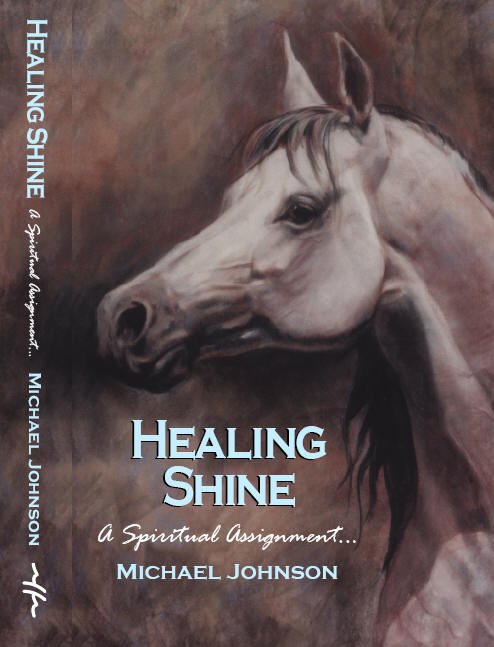
Every now and then you read a book that entertains you.
Sometimes you read one that teaches you something new.
And then, every once in a while, you stumble across a book that feels like someone has been quietly following your life, taking notes, and somehow putting your own experiences onto paper.
That's exactly how I felt reading Healing Shine by Michael Johnson.
One of the things that makes the book so unique is the way it's written. Throughout the story, the perspective occasionally shifts to the horse's voice. Not in a cartoonish or unrealistic way, but in a way that gently reminds us to stop viewing every situation through human eyes. It asks us to consider what the horse might be thinking, feeling, or trying to communicate. That simple shift in perspective changes everything.
As I read, I kept finding myself nodding along. The lessons felt authentic because they reflected the way good horses are developed, not through shortcuts or force, but through patience, consistency, and understanding. It reminded me how fortunate I've been to spend the last six months learning those same principles from Sarah and with Bee.
One of the earliest lessons in the book is deceptively simple.
Do it slow first.
Those four words seem almost too simple to matter, but the more I thought about them, the more profound they became. If you can't do something slowly, you probably don't understand it well enough to do it quickly.
Sarah has been teaching me that lesson since our very first rides together.
When I started riding with her in January, I wanted to accomplish things. I wanted to check boxes. Learn neck reining. Improve my lope. Ride outside the arena with confidence that Bee wouldn't take off. Build my seat. I measured success by what we could do.
Sarah measured success by something entirely different.
Slow my hands down.
Feel the engagement of the bit.
Wait for a response.
Let Bee breathe.
Reward the smallest try.
If something isn't working, don't push harder. Slow it down until both horse and rider understand the question.
At first, I thought slowing down meant slowing my progress.
I've since learned it's exactly the opposite.
The quieter my hands have become, the softer Bee has become. The more I've concentrated on my position and feeling Bee's response, the more willing she is to search for the right answer. Instead of reacting to every little thing, I'm beginning to feel what she's about to do before she does it. Those aren't milestones you can check off a list. They're little changes that happen one ride at a time until one day you realize you've become a different rider than the one who climbed into the saddle six months ago.
What struck me most while reading Healing Shine was realizing how often I'd experienced these lessons without recognizing them. Sarah has a way of quietly repeating the same principles until one day they simply become part of how you ride. Reading the book gave names to things I'd been feeling in the saddle for months.
The book also solved one of those little mysteries that had been floating around in my head for months but that I hadn't taken the time to look up.
As I've been looking for my next horse, I keep seeing advertisements describing horses as head horses or heel horses. Every time I'd read one, I'd think, Should I want one of those? Am I supposed to know what that means? I'd nod my head like I understood and then quietly move on to the next listing.
Healing Shine finally connected the dots.
For those of you who are as new to this terminology as I was, it comes from the rodeo event called team roping. Two riders work together to rope a steer. The head horse is ridden by the competitor who ropes the steer's horns, controlling the front of the animal. The heel horse is ridden by the partner who ropes the steer's back legs after the steer has been turned. Because they have very different jobs, they're trained differently.
A head horse is expected to leave the box quickly, rate the steer, face it, and hold it steady. A heel horse has to be incredibly patient and athletic, waiting for just the right moment before exploding forward to rope the steer's heels.
I had one of those, "Well...that makes perfect sense!" moments.
Now, when I see "head horse" or "heel horse" in a sale advertisement, I don't have to pretend I know what it means.
I actually do.
Another idea from the book made me stop and think because I immediately saw myself in it. The author talks about the temptation to send your horse to someone else to fix the problems.
At first, I smiled because my immediate thought was, Well...I did exactly that.
Then I kept thinking.
The truth is, I didn't just send Bee to Sarah.
I sent myself to Sarah.
Bee didn't need to be fixed nearly as much as I needed to learn how to communicate with her.
Yes, Sarah has helped Bee become softer, more confident, and more responsive. But she's also taught me how to ask better questions, recognize smaller tries, improve my timing, become a quieter rider, and understand what Bee has been trying to tell me all along.
In many ways, Bee and I have been students together.
Sarah wasn't fixing one of us.
She was teaching both of us to speak the same language.
Looking back, I don't think that's admitting failure.
I think it's admitting that experience matters.
Sometimes loving your horse means recognizing that someone else has knowledge you don't yet have. The goal isn't to hand your horse off and hope someone magically changes it. The goal is to become a better partner so that when your horse comes back to you, you're both ready to succeed together.
For me, that's exactly what happened.
In fact, the more I learn, the more I realize Bee has been my greatest teacher all along.
Olympian Lynden Gray once said, "It is the very difficult horse that has the most to give you."
I couldn't agree more.
When I first bought Bee, I wasn't looking for a difficult horse.
I was looking for a partner.
What I found was a horse that challenged me every single ride. She questioned my timing, exposed my inconsistencies, and quickly let me know when my communication wasn't clear. There were rides where I wondered if I was making any progress at all.
Looking back now, though, I don't even know that I'd call Bee a difficult horse.
I think she was simply a horse who knew more than I did.
She expected clarity, consistency, and confidence. Once I started learning those things, she started saying "yes" a lot more often.
If Bee had been the perfect, push-button horse from day one, I might have learned to ride her.
Instead, she taught me how to become a rider.
That reminds me of another quote in the book from Alois Podhajsky, the legendary Director of the Spanish Riding School in Vienna:
"I must not forget to thank the difficult horses that made my life miserable but who were better teachers than well-behaved school horses who raised no problems."
That one made me smile because I knew exactly what he meant.
The horses that challenge us aren't trying to make our lives difficult. They're revealing the holes in our own knowledge. They force us to become quieter, more patient, more observant, and more humble. They ask us to grow into the rider they need instead of expecting them to become the horse we imagined.
Looking back over these past six months, I realize Bee has taught me far more than riding. She's taught me patience, consistency, humility, and the importance of listening before reacting. Those lessons didn't come all at once. They came one ride at a time, often without me realizing it until much later.
Maybe that's why Healing Shine resonated with me so deeply.
It didn't feel like I was reading someone else's story.
It felt like someone had found the words for experiences I'd already been living.
If you're a horse person, I think you'll appreciate the book for its unique perspective and gentle wisdom.
And if you're lucky enough to have a horse that's teaching you lessons you didn't know you needed...
Pay attention.
They might just be writing your story, too.
Horse Sense
One of the themes woven throughout Healing Shine is learning to see the world through the horse's eyes.
That isn't just good storytelling. It's good horsemanship.
Horses are prey animals. Their first instinct is to notice change, evaluate pressure, and look for safety. They don't naturally understand what we're asking of them. They learn through consistency, timing, and the release of pressure. That's why experienced trainers so often tell riders to slow down. Giving a horse a moment to process a request often leads to a better response than immediately asking again.
The book also reminded me that every horse has something to teach us. Some lessons come from the easy, forgiving horses that quietly build our confidence. Others come from the horses that challenge us to improve our timing, patience, and communication. As Lynden Gray and Alois Podhajsky both observed in different ways, the horses that ask the most of us often leave the deepest mark on us as riders.
Many horsemen have a saying:
"Slow is smooth, and smooth becomes fast."
The science supports that philosophy. Horses learn best when cues are clear, consistent, and followed by a timely release of pressure. Rushing often creates confusion, while patience builds understanding and confidence.
Sometimes the fastest way to progress really is to slow down first.
PS: He’s got two other books in this series, so if you like it there’s more!