
October 2, 2026: Fall Is in the Air
Something happened in Texas this week that I wasn't entirely sure was ever going to happen again.
The temperature dropped.
Not dramatically. We're still in Texas, after all. But there was enough of a change in the air that both the humans and horses seemed to notice. After months of riding in oppressive heat, cooler mornings suddenly feel like a gift. Of course, anyone who owns horses knows that a weather change can also make you look at your horse and wonder, Are you feeling good today, or are you feeling GOOD today?
Bee has actually had a really good week. And perhaps the best news is that we are now another week into our experiment without Altrenogest, or Regu-Mate, and I haven't seen a significant change in her behavior.
She still pins her ears. She still has opinions. She is still very much a mare.
In other words, Bee is still Bee.
But I haven't seen the aggression or major behavioral change I was prepared for when we stopped suppressing her cycles. After spending so much time managing her anxiety and wondering how much of her behavior might be hormonal, I'm genuinely happy to see that. I'm not declaring the experiment finished yet, but every normal week gives me a little more confidence that perhaps she doesn't need the medication anymore.
And this week, we even went out on the trail.
Trail Riding Is Not Exactly Relaxing Yet
I don't trail ride Bee very often anymore, which probably sounds strange because trail riding is supposed to be the relaxing part of owning a horse.
You know the picture. Beautiful weather. Friends chatting. Horses walking quietly down the trail on a loose rein while everyone enjoys nature.
That is not exactly the Bee version.
When I'm riding Bee outside the arena, I'm working. Constantly.
Bee is athletic, alert and very aware of everything happening around her. Horses are prey animals, so noticing changes in their environment and reacting quickly to potential threats is part of how they are wired. With Bee, my job is to keep that awareness from turning into tension and that tension from turning into a much bigger reaction.
So while my friends may be admiring the scenery, I'm thinking about Bee's feet, shoulders, head, neck, attention and approximately 47 other things.
Relaxing isn’t one of them.
What Does It Mean to “Collect” a Horse?
One of the things I'm asking Bee to do to keep her mind busy is collect herself.
If you aren't a horse person, collection doesn't mean I'm gathering Bee up into a smaller horse. Although some days that would be convenient.
A horse naturally carries more of its weight on its front end. When we ask for collection, we're asking the horse to engage the hindquarters more, balance herself and carry her body in a more organized way rather than stretching out and letting all of her momentum fall forward. The hindquarters provide much of the power necessary for collection, and a rider's balance and cues help the horse achieve that self-carriage.
With Bee on the trail, I'm not looking for some fancy show-ring frame. I'm asking her to stay with me.
If she starts getting tense or distracted, I may put her into a circle. I may change direction. I may ask her to bend or move her feet. Rather than allowing her to lock onto whatever has captured her attention and build more and more tension, I give her something productive to do.
It's basically the equine version of, Hello? We're still working together down here.
Soft Doesn't Mean Slow
I'm also constantly checking that Bee is soft and responsive.
Those are horse terms that sounded rather vague to me when I first started hearing them.
“Soft” doesn't mean sleepy or sluggish. It means that when I apply a small cue with my reins, legs or seat, Bee gives to that pressure rather than bracing against me. “Responsive” means I don't have to keep escalating the request. I ask quietly, and she answers.
That's where so much of our work with Sarah over the past several months is beginning to pay off.
I'm learning to feel Bee getting tense sooner. I'm learning not to wait until she has already made a decision and then try to correct it. Instead, I can move her feet, redirect her attention, ask for softness and then release the pressure when she gives me the response I'm looking for.
It is a LOT more work than sitting on a horse who strolls down the trail thinking about absolutely nothing except the next patch of grass.
But we went.
And we had a good ride.
That matters.
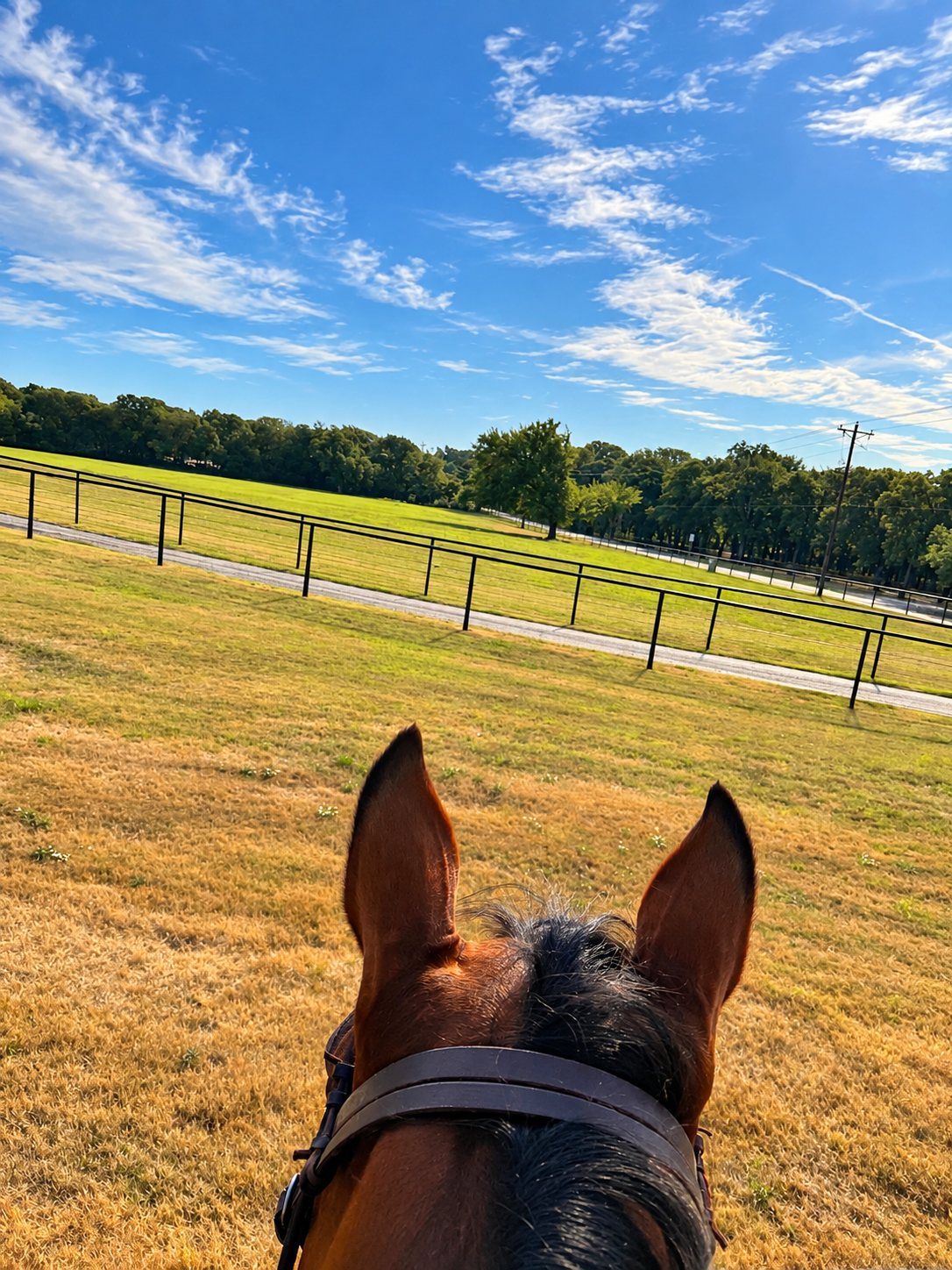
The best view is between the ears.
Weather Changes More Than the Temperature
Fall weather also brings some practical changes for horses that have nothing to do with whether they suddenly feel frisky.
Water intake is one of the big ones. As temperatures cool and horses transition toward eating more dry hay and less moisture-rich pasture (ha ha, there is not of that in Texas right now), keeping them drinking becomes particularly important. A 1,000-pound horse generally needs at least 10 to 12 gallons of water a day, and inadequate water intake can increase the risk of impaction colic. Research has also found that horses may drink more during cold weather when their water isn't icy cold.
Pastures change too. Frost and stressed forage can alter sugar concentrations in grass, which can be important for horses susceptible to metabolic problems or laminitis. If you recall, that’s why we started the grazing muzzle.
So while I'm enjoying finally walking outside without immediately sweating through my clothes, the barn is entering another season of paying attention.
That's horses. The weather changes, the grass changes, their needs change and occasionally their brains seem to change right along with everything else.
But this week, Bee handled it beautifully.
She's off the altrenogest. She's still appropriately opinionated. We left the arena. We rode the trail. I kept her feet moving, kept asking for softness and spent considerably more time managing my horse than admiring the scenery.
And somewhere along the way, I realized something.
A year ago, a ride like that probably would have made me nervous.
Now it just makes me work.
I'll take that progress.