
August 14, 2026: When Horses Get Hurt - Bee's Guide to Equine Emergencies
Hey! It's Bee.
Mom is in Florida with the "grandkids" this week. Apparently she's eating popsicles and mini-donuts, riding on boats and planes, and generally having a fabulous time without me.
It's not like I'd want to do any of those things. I don't even know what a mini-donut is.
Although, if it's food, I'm willing to reconsider.
Meanwhile, I'm still here in sweltering hot Texas, where Mom has arranged for Allyson to lunge me and Sarah to ride me while she's gone.
Seriously?
She gets vacation. I get a workout schedule.
What's this crap?
Since Mom isn't here to supervise, I thought I'd take over the Weekly Buzz myself. And considering what's been happening around here lately, it seems like a good time to make sure Mom and all her friends know a little something about equine first aid and emergency preparedness.
We've had a few reminders recently that horses are remarkably good at getting themselves into trouble.
My barn mate Beamer nearly coliced. Thankfully, Lupe recognized that something wasn't right, acted quickly, and after a trailer ride, things started moving through his digestive system again.
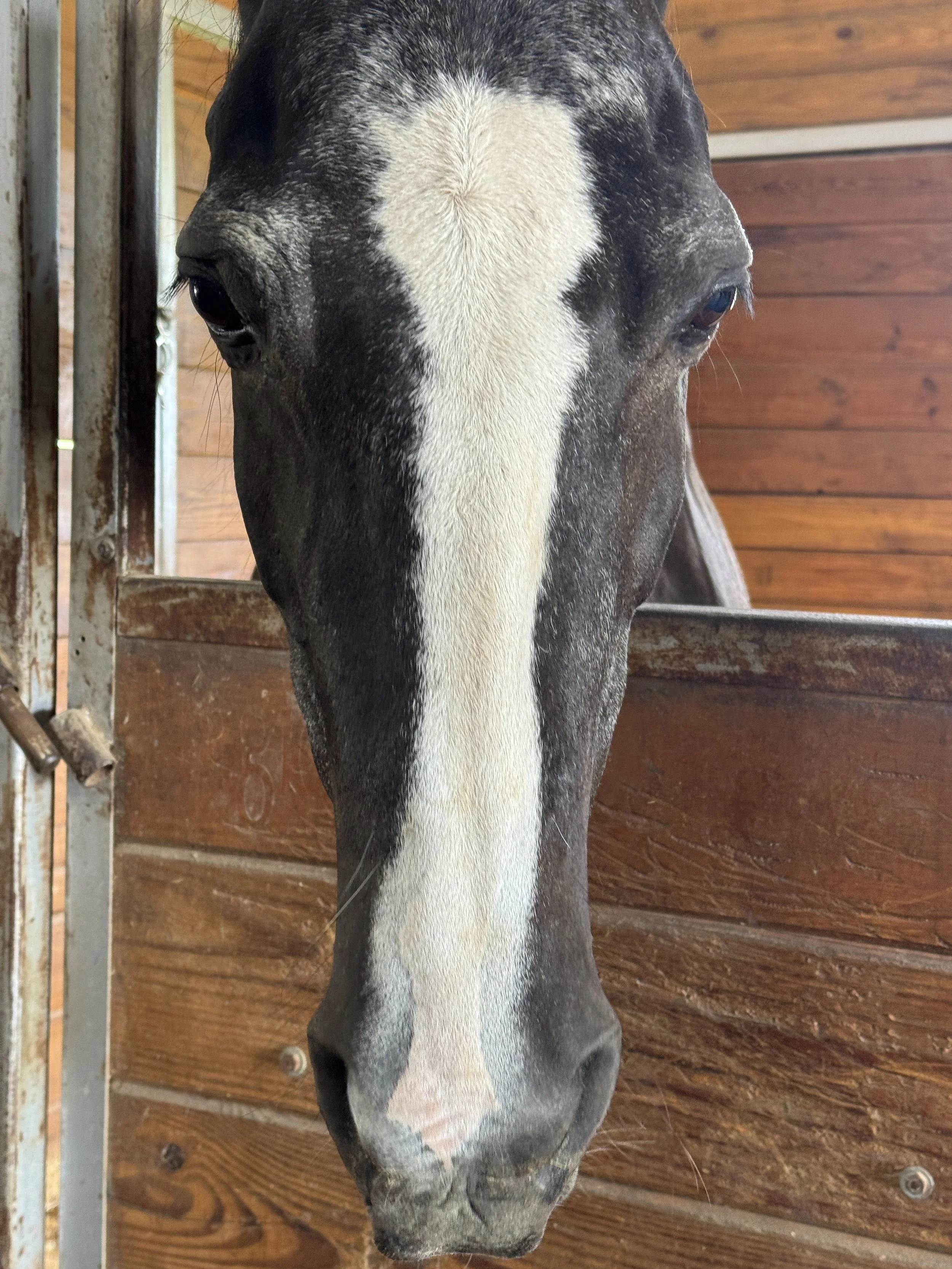
Magic has been dealing with a painful eye and has made a few trips to a specialty veterinarian to get it properly evaluated.
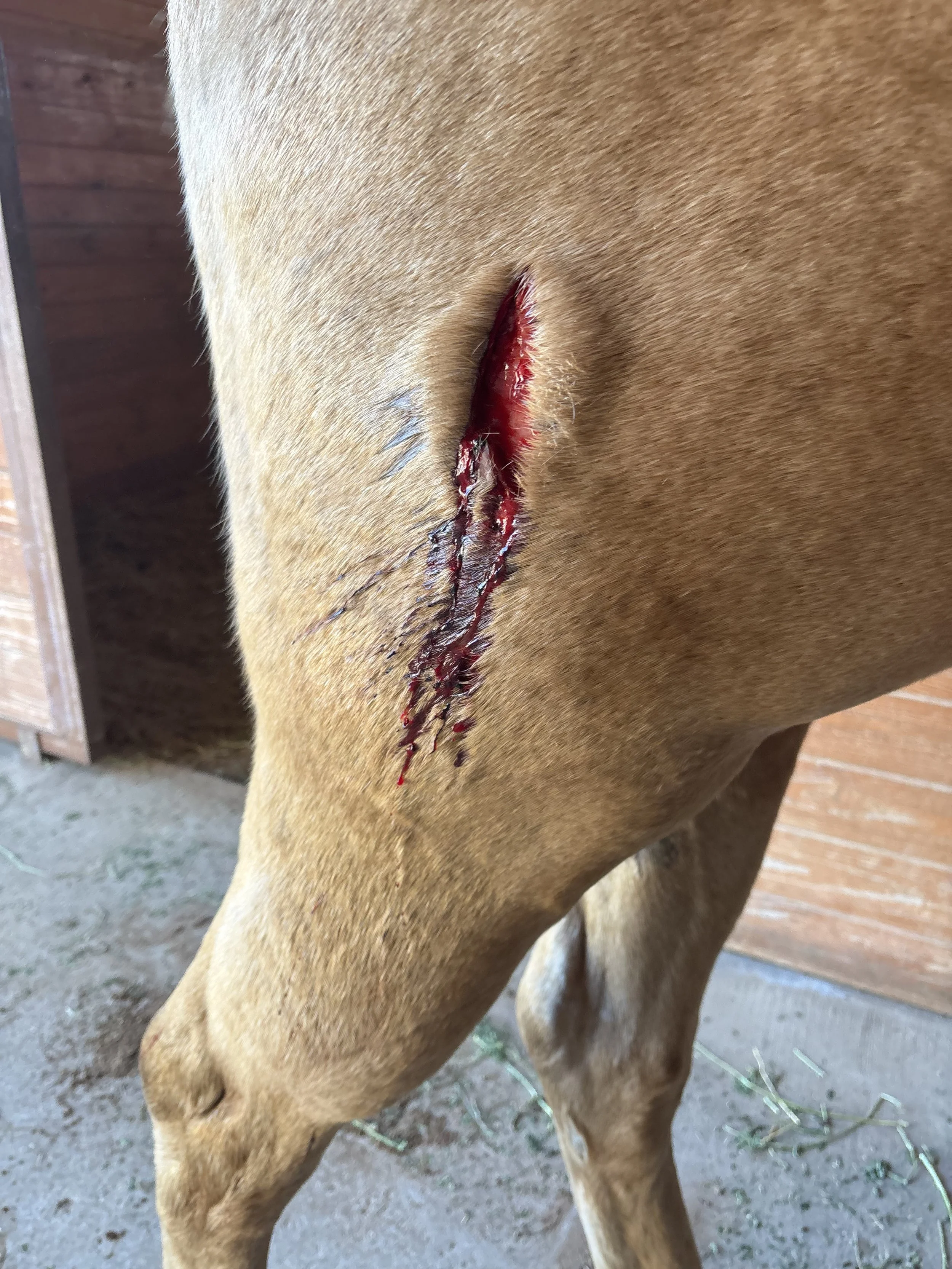
And my old friend Sunny suffered a nasty puncture wound somewhere on the property at the barn where I used to live.
Colic. Eye problems. Puncture wounds.
Apparently, we horses are a full-employment program for veterinarians.
So let's talk about what you humans should know when something goes wrong.
First, You Need to Know What Normal Looks Like
Here's the problem with us horses.
We can't tell you, "My stomach hurts," or, "Something feels funny."
Well, technically we tell you plenty. You humans just aren't always particularly good at listening.
That's why one of the most important things an owner can learn is what normal looks like for their individual horse.
Does your horse normally inhale dinner? How much does she drink? How often does she poop? What do her gums look like? How does she normally stand when she's relaxed?
Owners should also learn how to check basic vital signs: temperature, pulse and respiration, often shortened to TPR. Mom chronicled my, ahem, sickness and wrote a blog about it along with some quick facts almost exactly a year ago.
For a resting adult horse, a temperature around 99 to 101°F, a heart rate/pulse of about 28 to 40 beats per minute, and a respiratory rate of roughly 8 to 16 breaths per minute are commonly cited normal ranges. Healthy gums should generally be pink and moist, and when you press a finger against the gum and release it, the color should return in about one to two seconds.
But here's the important part: learn your horse's normal numbers when they're healthy.
Mom learned the importance of that when my temperature once climbed over 104°F.
Even she knew that wasn't a "let's see how Bee feels tomorrow" situation.
Vet. Now.
What Should Be in a Horse First-Aid Kit?
When your patient weighs somewhere around half a ton, first aid looks a little different than putting a Band-Aid on the family dog.
Every barn should have a well-stocked first-aid kit, and Mom should probably have one specifically for me because obviously my care is the priority around here.
Some basics include:
A digital rectal thermometer
Disposable gloves
Sterile gauze pads
Nonstick wound dressings
Rolled gauze
Self-adhering wrap such as Vetrap
Bandage padding
Blunt-tip scissors
Clean towels
Saline or another veterinarian-approved wound rinse
A flashlight or headlamp
The flashlight is important because horses apparently haven't received the memo that emergencies should only happen between 9 a.m. and 5 p.m.
Medications are different. Owners should talk with their veterinarian about what medications are appropriate to keep on hand for their particular horse and exactly when to use them.
Just because something like Banamine is sitting in the tack room doesn't mean you should automatically give it every time a horse looks uncomfortable. Your veterinarian may want to evaluate the horse's symptoms first, and the correct medication, dose and method of administration matter.
In other words, humans, resist your overwhelming urge to Google, diagnose and medicate us yourselves.
Cuts, Scrapes and Punctures
If you've never owned a horse, you might wonder how we manage to hurt ourselves in seemingly safe environments.
It's a gift.
For significant bleeding, the immediate goal is to control it with firm, direct pressure while contacting the veterinarian. Keeping an injured horse calm and preventing additional injury are also priorities.
But here's something important: the size of a wound doesn't always tell you how serious it is.
A small puncture can be much more concerning than a big superficial scrape, particularly if it's near a joint, tendon sheath or other important structure.
That's why Sunny's puncture wound deserved attention. (See right).
Deep punctures, significant bleeding, contaminated wounds, exposed tissue and wounds near important structures should be evaluated by a veterinarian.
And owners should know their horse's tetanus vaccination status. Horses are particularly susceptible to tetanus, and wounds are one reason keeping those vaccinations current matters.
Magic's Eye Is a Good Reminder
Eyes get their own category because horse eye problems can become serious remarkably quickly.
Squinting, excessive tearing, swelling, cloudiness, holding the eye closed or obvious trauma warrant prompt veterinary attention. Eye injuries can threaten vision, and some cases are best handled by a veterinary ophthalmologist, which is exactly why getting the right care matters.
This isn't the time to rummage around the medicine cabinet and try whatever eye ointment happens to be there.
If the eye hurts, call the vet.
Magic would agree. (See Magic’s left eye swollen and squinting).
Then There's Colic
If you're not a horse person, you've probably heard the word colic without really knowing what it means. For more information check out mom’s prior Bonus Buzz blog.
Colic isn't one particular disease. It's a general term for abdominal pain.
Sometimes the cause is relatively minor. Other times an intestine can become displaced, blocked or twisted, making colic a potentially life-threatening emergency.
A horse with colic might paw, look repeatedly at its belly, refuse food, sweat, stretch, lie down repeatedly, roll, kick at its abdomen or stop producing its normal amount of manure.
This brings us back to Beamer.
His people knew something wasn't right and acted.
Interestingly, a trailer ride sometimes seems to coincide with manure finally appearing. Movement may help some horses with mild digestive upset, but nobody should interpret that as "the cure for colic is putting your horse in a trailer." Colic has many causes, some of them surgical emergencies.
The important part of Beamer's story is that his people recognized the signs and responded quickly.
If a horse is showing colic symptoms, the veterinarian may want to know when the horse last ate, drank and passed manure; when the symptoms began; whether feed or routine recently changed; and the horse's temperature, heart rate and respiratory rate.
There's another strange thing about us that makes intestinal problems particularly dangerous.
Horses cannot vomit.
If fluid or gas accumulates in the stomach because of an intestinal blockage, pressure can become dangerous. Veterinarians may pass a long tube through the horse's nostril and into the stomach to release fluid or gas. It's called nasogastric intubation, and in some cases it can be lifesaving.
Mom has seen that one firsthand with me.
I don't recommend it.
Zero stars.
Choke Doesn't Mean What You Think It Means
Humans hear "choke" and immediately think a blocked airway.
Horse choke is different.
Usually, food has become lodged in the esophagus, which is the tube carrying food from the mouth to the stomach. A choking horse may cough, drool, repeatedly try to swallow, or have saliva and food material coming from its nostrils.
It's frightening to see and requires a veterinarian.
Take away the food and call for help. Don't start pouring water, mineral oil or anything else down the horse's throat. Material can end up in the lungs and cause aspiration pneumonia.
When Do You Call the Vet?
Mom says this was one of the hardest things for her to learn as a newer horse owner.
What's an emergency?
What can wait?
What needs watching?
And when do you make the call?
Personally, I think you should call the veterinarian anytime I experience even the slightest inconvenience.
Apparently, veterinary medicine doesn't work that way.
There are, however, some things that deserve prompt attention:
Severe or persistent colic signs, especially a horse that cannot get comfortable
Significant or uncontrolled bleeding
Eye pain, injury, cloudiness or a horse holding an eye closed
Choke
Sudden severe lameness or inability to bear weight
Neurological signs such as stumbling, loss of coordination, seizures or unusual behavior
Serious heat stress or a horse that isn't recovering normally after cooling
A dramatic change from that horse's normal behavior
Heat stroke is a true emergency. Weakness, incoordination, collapse, abnormal breathing and a horse that isn't cooling normally all deserve immediate attention. Active cooling, shade and airflow should begin while veterinary help is sought.
And there's one more category:
"I don't know what's wrong, but I know my horse and something isn't right."
That counts.
You don't need to diagnose us before calling the veterinarian.
That's literally why they went to veterinary school.
Know How You're Getting Us There
Here's something dog and cat owners may never have considered.
If your Labrador gets sick at 2 a.m., you can put him in the back seat and drive to an emergency hospital.
Good luck doing that with me.
Every horse owner needs an emergency transportation plan.
Who has the truck?
Who has the trailer?
Who can haul in the middle of the night?
Where is the nearest equine emergency hospital?
How long will it take to get there?
Will your horse load when frightened, painful or sick?
Veterinary emergency guidance specifically recommends having emergency phone numbers, directions and transportation plans ready before they're needed.
Mom should have those numbers saved in her phone, but there should also be a physical copy at the barn where someone else can find it.
Because phones die.
Owners travel.
And apparently some people abandon their horses entirely and go to Florida to eat mini-donuts.
Sometimes First Aid Means Doing Less
This one may be difficult for you humans.
When something is wrong, you immediately want to do something.
Move us.
Walk us.
Bandage us.
Clean something.
Give us medication.
Google something.
Ask seven people in the barn.
Post it in a Facebook group.
Sometimes the smartest first aid is keeping the horse calm, preventing further injury, calling the veterinarian and following instructions.
And remember, even the sweetest horse can become dangerous when frightened or in severe pain. A 1,000-pound animal reacting instinctively can hurt someone without intending to. Human safety matters too.
Every Horse Should Have an Emergency Card
Since I'm apparently running things this week, I've decided Mom has homework when she gets back from Florida.
She's making me an emergency card.
Every horse owner should probably do the same.
It doesn't need to be fancy. It just needs to contain the information someone might need quickly:
HORSE INFORMATION
Horse's name
Age and breed
Approximate weight
Normal resting temperature
Normal resting heart rate
Normal resting respiration
Current medications
Medication allergies or previous reactions
Important medical history
Date of last tetanus vaccination
EMERGENCY CONTACTS
Owner
Barn manager
Primary veterinarian
After-hours veterinarian
Equine emergency hospital
Farrier
TRANSPORTATION PLAN
Primary hauling contact
Backup hauling contact
Preferred emergency hospital
Approximate drive time
I'd keep one with the first-aid supplies, another in the tack room and a copy on the owner's phone.
Filling it out also exposes the things you don't know.
Don't know your horse's normal resting pulse?
Go take it.
Can't remember when the last tetanus booster was?
Check the records.
Don't know who could haul your horse at 2 a.m.?
That's something to figure out at 2 p.m.
First aid isn't about turning horse owners into veterinarians.
It's about knowing enough to recognize when something is wrong, keeping the situation from becoming worse, gathering useful information and getting appropriate help quickly.
Hopefully, the thermometer stays in the first-aid box.
Hopefully, the emergency trailer plan gathers dust.
And hopefully Mom comes home from Florida soon.
Preferably with a mini-donut.
Because after writing her entire blog for her, I think I've earned one.
Love,
Bee
P.S. Mom, Sarah rode me while you were gone.
We need to discuss your definition of "vacation."