
January 23, 2026: Shoes, Stretchy Tendons, and Blanket Crimes
Hello. It’s Bee.
And I would like to formally document the injustice of this past week.
Before we get into the actual drama, I should mention that the week came with a guest. Mom brought along Mrs Kathrerine “Kitty” Skitt, her next-door neighbor, to observe my pedicure and have some equine therapy — I fully approved. Miss Kitty arrived with carrots, excellent grooming skills, and the correct attitude for a proper pre-farrier spa experience. She brushed me, groomed me, and made my Wednesday feel less like “maintenance appointment” and more like “luxury wellness retreat.” Highly recommend. Five stars. Would allow her back anytime.
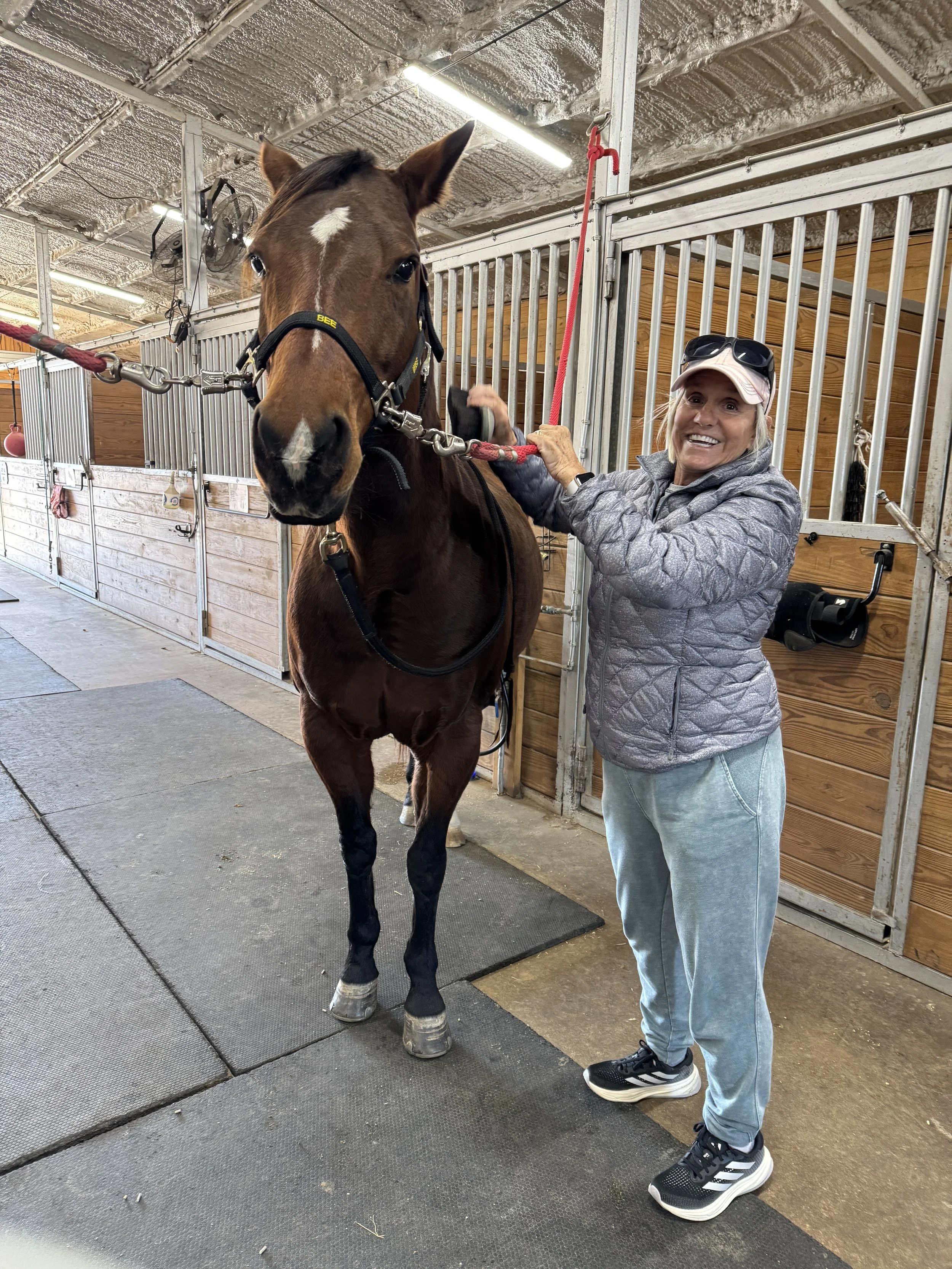
Every horse deserves a Miss Kitty before a pedicure. Mom made me open my eyes for the picture.
Let’s start with my pedicure, because that’s where the drama began. Daniel Meegan (the Natural Barefoot Farrier), my farrier, has been working absolute magic on my feet. Thanks to the EasyCare shoes I’m wearing now (see October 24, 2025 blog post about these shoes), my heels have been growing properly. For a long time, they were growing forward instead of down, which is not ideal if you enjoy comfort and soundness. That kind of growth is why I historically needed wedged shoes.
With the progress I’ve made, we were finally able to eliminate the wedge. That’s a win. A big one. But it also likely explains why I felt a little sore afterward. When you change angles and mechanics, tendons and ligaments have to adjust. Think of it like wearing heels for years and suddenly switching to flats. Your feet may rejoice, but the rest of your body has opinions.
So while my feet looked great, my tendons were probably feeling a little stretched and unhappy. It happens sometimes, especially with front feet that do a lot of work. My mom noticed right away because she notices everything.
I wasn’t out there with a flashing neon sign that said “ow.” When I’m sore, the clues are subtle. Shorter steps. A tiny head bob when weight hits the wrong spot. Less reach, less swing, more stiffness. Maybe I don’t want to turn one way or stand evenly. Sometimes it shows up as extra attitude or tension instead of a limp. Mom noticed it after my lesson on Thursday, following the farrier visit, when we were walking on harder ground and I just felt off. Not dramatically lame, but not quite right either. Horses whisper long before we shout.
Enter phenylbutazone, also known as Bute.
I did not request it.
I did not sign anything.
But I did accept it.
I received Bute on Friday and Saturday to help with inflammation and soreness. It’s commonly used in horses, but it’s not something meant for long-term use. Over time, it can cause stomach irritation and ulcers, so my mom limited it to two days. Friday and Saturday were full rest days. Sunday too, but without meds, because apparently she likes to see how things are actually healing.
Monday rolled around and I was feeling much better. Still, I was given another day off because we believe in listening to horses, not just sticking to a schedule.
Honestly, I could get used to this pace.
I should also mention that even though I looked better on Monday, I was still lame, which meant in her usual helicopter-mom let’s check all the boxes fashion, Mom asked Daniel to come back out for what I would call a full investigative episode even though we knew it was probably those tendons and ligaments still stretching out.
He started by looking me over head to toe, checking my feet, my shoes, my balance, and how I was standing. Was I shifting weight? Guarding anything? Plotting an escape? All important and fair questions. How does he already know me so well?
Daniel checked my legs for heat and touch tenderness, aaaah massage. He moved down to my hooves for sensitivity with the shoe on, then took the shoe off and checked again. No, I can’t feel you pinching me Daniel. Which was both reassuring and mildly annoying to my mom since it meant we still had to keep looking.
Then came the weird shoe thing. Daniel strapped a temporary shoe onto my foot with a little rotating dial underneath it. As he turned the dial to different spots, he asked me to lift my other leg so I had no choice but to fully stand on the foot being tested. Daniel graded how willing I was to bear weight in each position. This wasn’t about sharp pain. It was about comfort. And I had opinions.
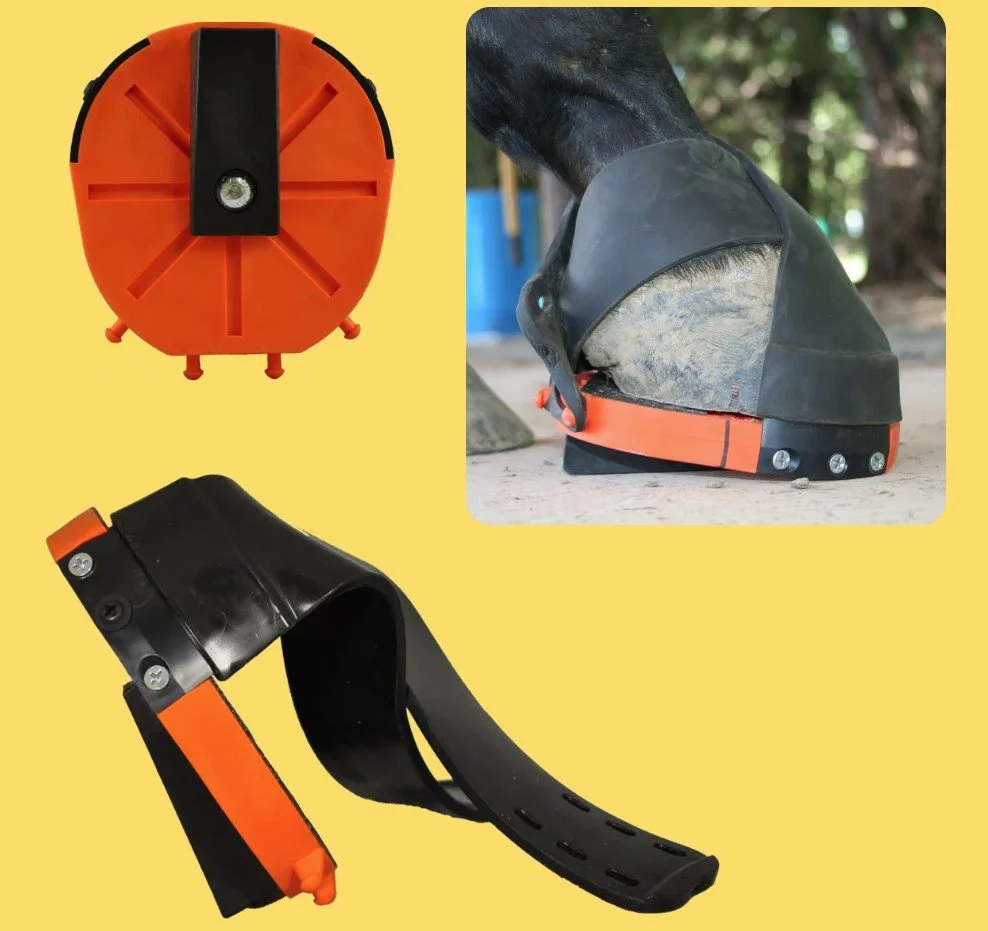
The device is a leverage testing device made by KrosschecK (“KLTD”).
From the KrosschecK website: “The dial on the bottom of the KLTD allows you to challenge the joint in 8 different locations and easily evaluate the comfort or discomfort of soft tissue primarily, but also the joint surface in some instances. Radiographs, MRI, and Ultrasound are great tools for seeing the details of most lesions, tears, breaks, or abnormalities of a particular structure in the foot or limb. However, what they can't do is show pain. The KLTD is a complimentary tool that fills that void in the diagnostic workflow without the need to do more extensive injections or blocks. From a farrier’s standpoint where diagnosing lameness is not their job, the ability to test the lower limb to help sort out what can be applied to the foot to PROVIDE COMFORT and set the horse up to heal is a job the KLTD can help farriers achieve.
Next, I was walked and trotted in the barn on straight lines. That’s when we noticed I was landing on the outside of my foot first and then rolling inward. Humans might call that supination. I call it rude. We tweaked both shoes just a bit and tried again. Straight lines looked better, which felt promising. Then we went outside and added circles at the trot and, surprise, the lameness showed up again. Circles are very good at exposing things you hoped might stay hidden.
At that point, even though the timing made my new shoes look suspicious, it became pretty clear this wasn’t actually a foot issue. It’s likely muscular. The plan now is a full week of rest and continued Bute per vet recommendation, then reassess. With the cold weather coming, I would have been resting anyway.
My only complaint is that I just learned a lot of very important things from Sarah last week and now I’m not allowed to practice them. Which feels plain rude and deeply unfair.
Now let’s talk about winter, because winter changes everything. Temperatures were expected to drop below freezing, which sent my mom into full management mode. Horses naturally drink less water when it’s cold. Cold water is less appealing, thirst signals are muted, and we’re not sweating as much. The problem is dehydration still happens, and it can lead to impaction colic. Gulp.
So hydration became a priority.
That’s where Purina RepleniMash comes in. It’s a dry mash made of tasty and useful things like beet pulp, barley, carrots, salt, flaxseed, and electrolytes, all designed to encourage me to drink water. She tried this with me before and I was deeply suspicious. This time, I remembered it was actually kind of good.
Friday I tolerated it.
Now I’m fond of it.
Please do not tell anyone.
Friends. I drank almost four gallons of water.
If you’ve ever seen a baby with a smash cake, that’s the energy. Messy. Dramatic. Slightly offended. Still finished every last bite. Or in my case, every last sip.
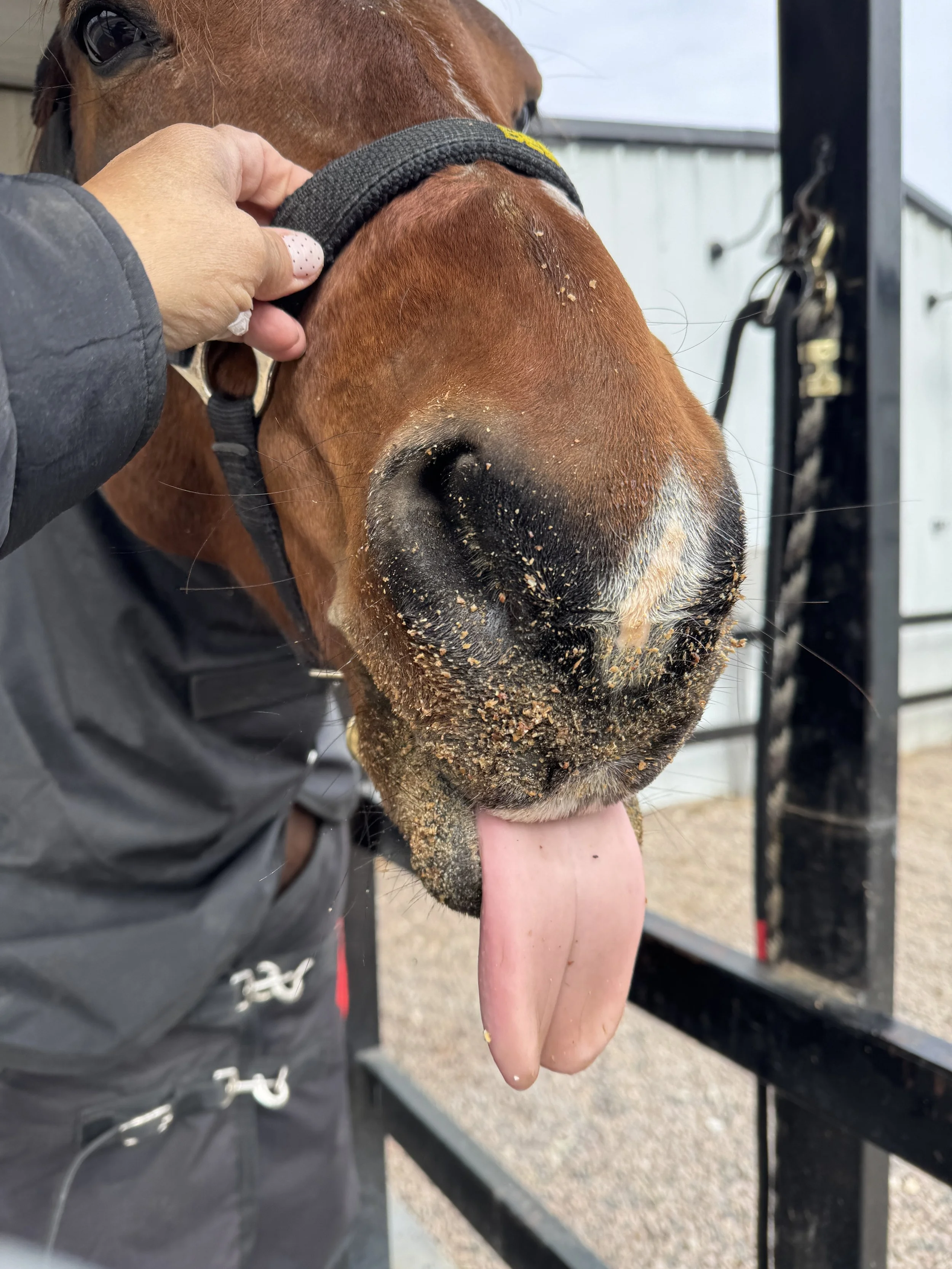
RepleniMash happened. Dignity did not.
Cold weather also means blanketing decisions. I was blanketed for only the third time this winter, with more cold days coming. I handled it just fine until I decided the belly band did not deserve to live. I ripped it clean off.
So now my mom is on the hunt for a seamstress capable of repairing heavy-duty, seatbelt-style material. Apparently, not everyone specializes in horse blanket surgery.
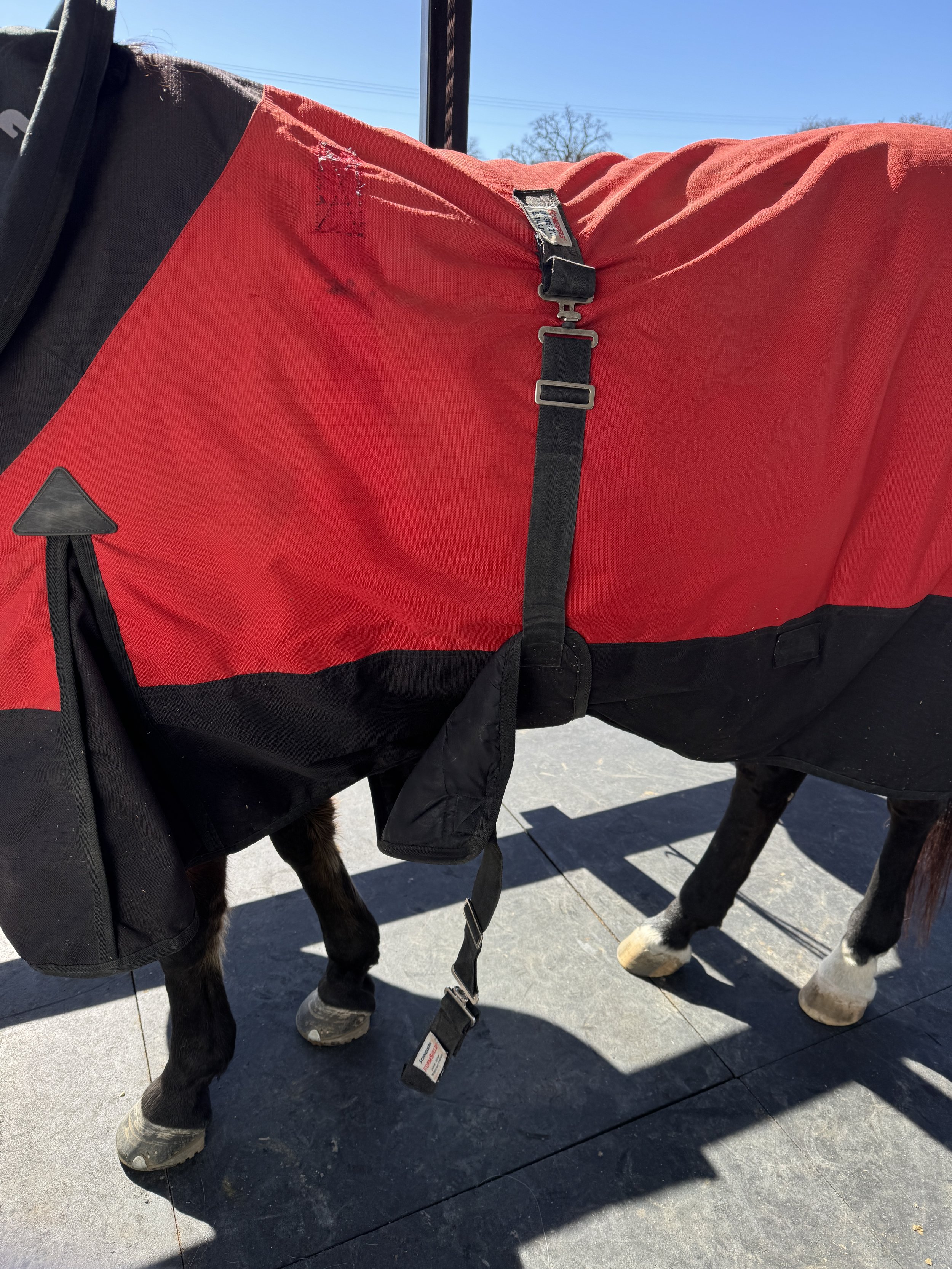
I didn’t like the belly band. So I fired it.
We’re lucky that my first mom, Jackie, sent me home with a heavier blanket. With temperatures dropping into the teens, that one may need to make an appearance while my usual blanket waits for repairs.
Before I wrap up this week’s list of grievances, we should talk about training. We’ve had our first two sessions with Sarah Salter, and lesson one was exactly what it needed to be. An assessment. Of both me and Mom. I assessed Miss Sarah too. I have standards.
That first session involved a lot of round pen work. Sarah lunged me and rode me so she could see how I move, how I react, where I brace, and how I respond to pressure and release. My mom stood there absorbing information and quietly realizing she has some habits to unlearn.
I also showed up with some changes. Mom borrowed a twisted snaffle bit, headstall, and split reins from a friend. No tie-down on my nose. And no extra hardware attached to my bit to add pressure. Less equipment and clearer communication can be a good thing. Mom had no idea what to do with two separate reins that weren’t attached to each other!
Lesson two focused on softening me up around my mom. I can be pretty bracey. Some of that may come from how I’ve been ridden in the past, and some of it may come from how I’ve been ridden recently. We’re not pointing fingers. We’re learning.
We started on the ground, asking me to walk a tight circle around my mom with my nose tipped in toward her. The goal wasn’t just head and neck position. It was my whole body. Were my shoulders doing what they should? Was my hind end staying engaged? Was my head low and relaxed instead of up high and tense? Was I paying attention, licking and chewing, and mentally connected?
Once I softened on one side, we switched and did the same work on the other. When I was responsive and relaxed, we moved to the arena. Same idea, but now with my mom on my back and a cone as our guide.
Perfect circles around the cone. Right hand for steering. Left hand for speed control. Leg pressure to keep me rounded instead of making flat tire shapes. Meanwhile, my mom is thinking about her hands, her legs, her breathing, her posture, and her balance. How does she think of all those things at once? Oh, I forgot, she’s a girl too, we know how to multi-task!
Anyone who thinks you just hop on a horse and don’t get a workout is sorely mistaken.
We ended the lesson with Sarah hopping on and loping those same circles. I worked hard. I’m trying. I’m a fast learner and I want to do what’s being asked. My mom just needs to get her act together so she can be a better rider and leader for me.
Winter horse care is proactive. It’s watching small changes, adjusting plans, and sometimes doing less so you can do more later. I may not say thank you, but I do notice when my body feels better.
Even if I express it by destroying equipment.
Until next week,
Bee 🐴
Warm. Hydrated. Sound. Slightly destructive.