
April 17, 2026: Learning the Language
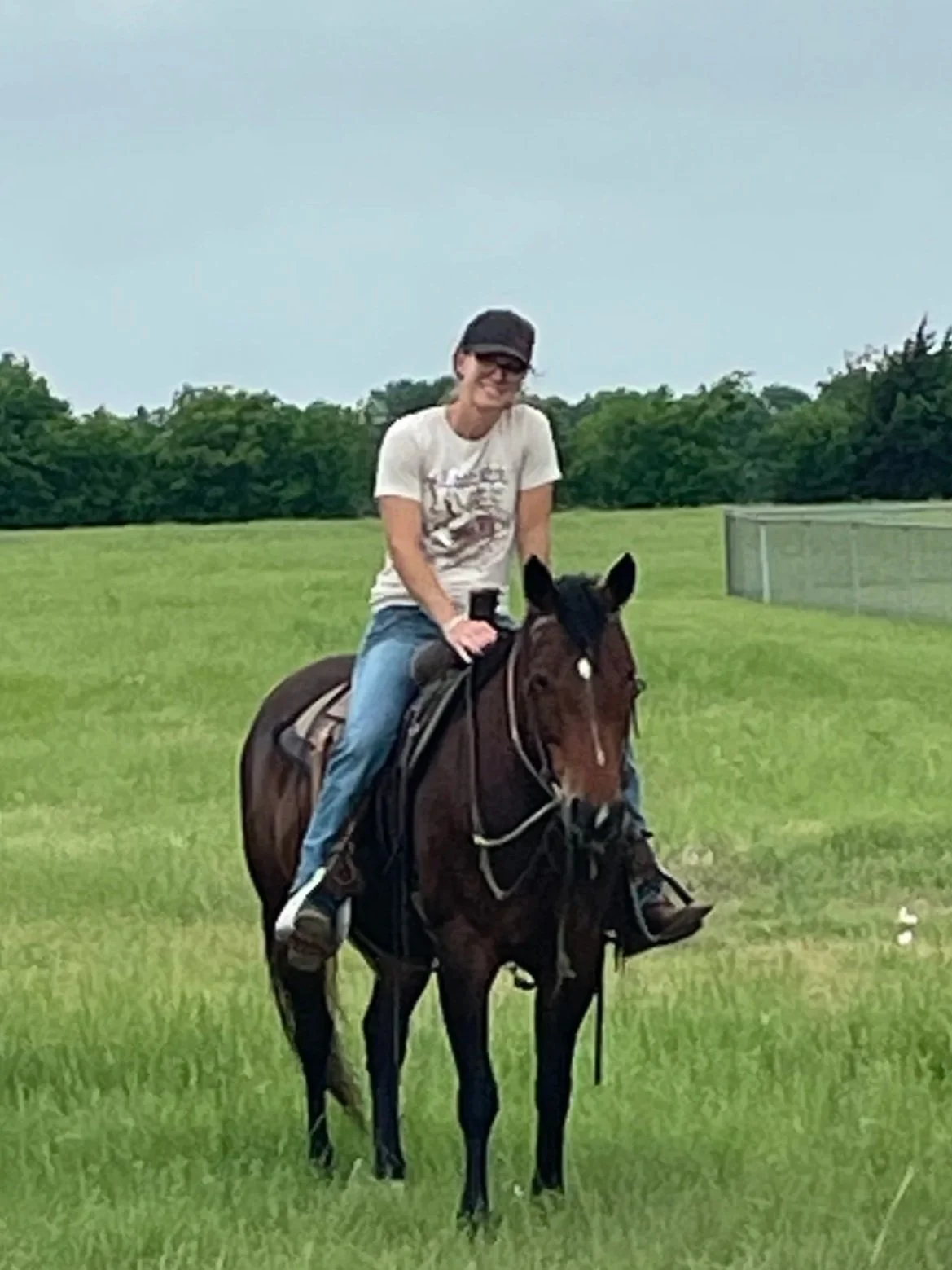
Not a great pic (I was the photog) but what is great is Bee relaxed and in-tune. Love that for her.
This week has been all about refining and building on what I already know.
Training continues, and while I’ve been missing all my barn ladies, I’m really enjoying the opportunity to focus on the details. It’s amazing how much more there is to uncover when you slow things down and get intentional.
This week’s focus has been rein management. I’ve always used reins for direction and control, but I’m learning just how nuanced that communication can be. There’s a whole layer of feel and timing that makes everything more precise and effective.
Coming from barrel riding, I was used to a much shorter rein. One loop, more contact, more control, or at least what I thought was control. What I didn’t realize is how much pressure I was actually putting on Bee’s mouth. Horses are incredibly sensitive there, and even something as small as tightening and relaxing your grip on a loose rein sends a signal. I didn’t fully appreciate that until now.
So now I’m learning to ride with slack in the reins, softer hands, and a lot more awareness. My arms are more relaxed, sometimes even higher than I would have expected, and I’m paying attention to the smallest movements. It feels like a complete reset, but it matters because everything Sarah is teaching me is exactly what she is using on Bee. If I want to be consistent with her training when she comes back home, I have to learn the same language.
We’ve also been working on softness, not just in the mouth, but through her whole body. That means learning how to influence the shoulders, move the hind end, and keep forward motion while everything stays connected. It is less about controlling the horse and more about guiding them in a way they understand.
We repeated Monday’s lesson this week because I just wasn’t getting it. I was trying to turn a circle to the right by pulling my right rein up and out, using my inside leg to keep the circle wide while moving forward. In my head, it made sense. In reality, it wasn’t working.
What I should have been doing was almost the opposite. Instead of pulling, I needed to slightly tip the horse’s head to the inside with my right hand, while my left hand controlled forward motion, speed, and the turn. For tighter turns, it became even more counterintuitive. Keep the body straighter, use the outside leg, and move the feet over rather than bending everything into the turn.
It felt backwards, until it didn’t.
There is a moment when it clicks, when you stop trying to force it and start to feel it. When that happens, everything gets quieter. The horse responds differently, and so do you. That was this week. I finally started to understand what Sarah has been trying to teach me, and more importantly, what Bee has probably been trying to tell me for a while.
I’m waiting to hear Sarah’s full update on Bee this week, but I got a glimpse of progress. After lunging and some arena work, they headed out to the pasture, and Bee was cool, calm, and collected. Super chill, even with dark, threatening skies and the wind blowing like crazy. We both kind of looked at each other like… where is this version of Bee every day? It’s not always like that… yet. But it’s in there, and that feels like progress.
As for Bee, Sarah shared something this week that really stuck with me. She said Bee is at the point where she’s starting to trust her more and, just as importantly, beginning to respect her decisions instead of reacting with anxiety.
Sarah explained it in a way that made so much sense: “She’s learning that I say what I mean and I mean what I say, and respecting those boundaries is what keeps her calm.”
That hit me.
She also said Bee isn’t at a place yet where she would add any more pressure than Bee already puts on herself. Which, if you’ve met Bee, you know is saying something. A lot of this isn’t physical, it’s what’s going on in her head.
So of course I said, “So with her it’s all head games, huh? You’re basically her psychiatrist.”
And without missing a beat, Sarah said, “Yep. Horses need help with their people problems… just like people need help with their people problems.”
She sees a common denominator. And the more I think about it, the harder it is to argue with.
Turns out, Bee and I are both learning to think a little differently, and it’s starting to come together in a really good way.
I’ve said this before, but training and progress are not linear, they’re jagged. A few steps forward, one step back, and then a few more forward. I’m looking for progress, not perfection.
Until next time,
Christina & Bee 🐝💛