
August 28, 2026: Bath Time With Bee - Rinse, Scrub, Repeat
Before I owned a horse, bathing one sounded pretty straightforward. Get horse wet. Add soap. Rinse horse. Congratulations, clean horse.
Like nearly everything else I've learned since owning Bee, there turned out to be considerably more to it.
There are cross ties, hoses, grooming mitts, shampoo, conditioner, face brushes, sweat scrapers and towels. There's a proper way to introduce the water, places you need to clean that aren't immediately obvious, and a surprising amount of thought that goes into keeping a mane and tail healthy. Then there's the horse herself, who may have very strong opinions about which portions of the spa package she ordered.
Bee certainly does.
Washing her legs? Fine. Body? No problem. Belly? Apparently, as I've recently discovered, this may be one of the greatest things that's ever happened to her. But historically, once the hose starts traveling toward her upper neck and face, Bee has acted as though I've violated several provisions of the Geneva Convention. She moves away, throws her head and makes it abundantly clear that THIS PORTION OF THE SPA PACKAGE WAS NOT REQUESTED.
Unfortunately for Bee, I've also learned that "I don't like it" and "we aren't going to learn how to do it" are two very different things. So we've been working on it. In the process, I've learned more about bathing a horse and discovered that Bee doesn't actually hate having her face washed nearly as much as I thought she did.
First Stop: The Cross Ties
Before the hose ever comes on, Bee goes into the cross ties in one of our wash bays. For my non-horse friends, cross ties are two straps or ropes attached to opposite sides of an aisle or work area that clip to rings on either side of a horse's halter. Instead of being tied to a single point in front of her, the horse stands centered between the two ties. This gives us access to both sides of her while helping keep her positioned in the work area.
We use cross ties constantly at our barn. We have four sets throughout the barn aisles, cross ties in each wash bay and another set in the farrier bay. Horses can stand in them while being groomed, tacked and untacked, bathed or handled for routine care. Our farrier bay provides a flat work area where horses can stand while their hooves are trimmed or shod. Safe cross-tie areas should have secure attachment points and nonslip footing, and horses shouldn't simply be clipped in and forgotten.
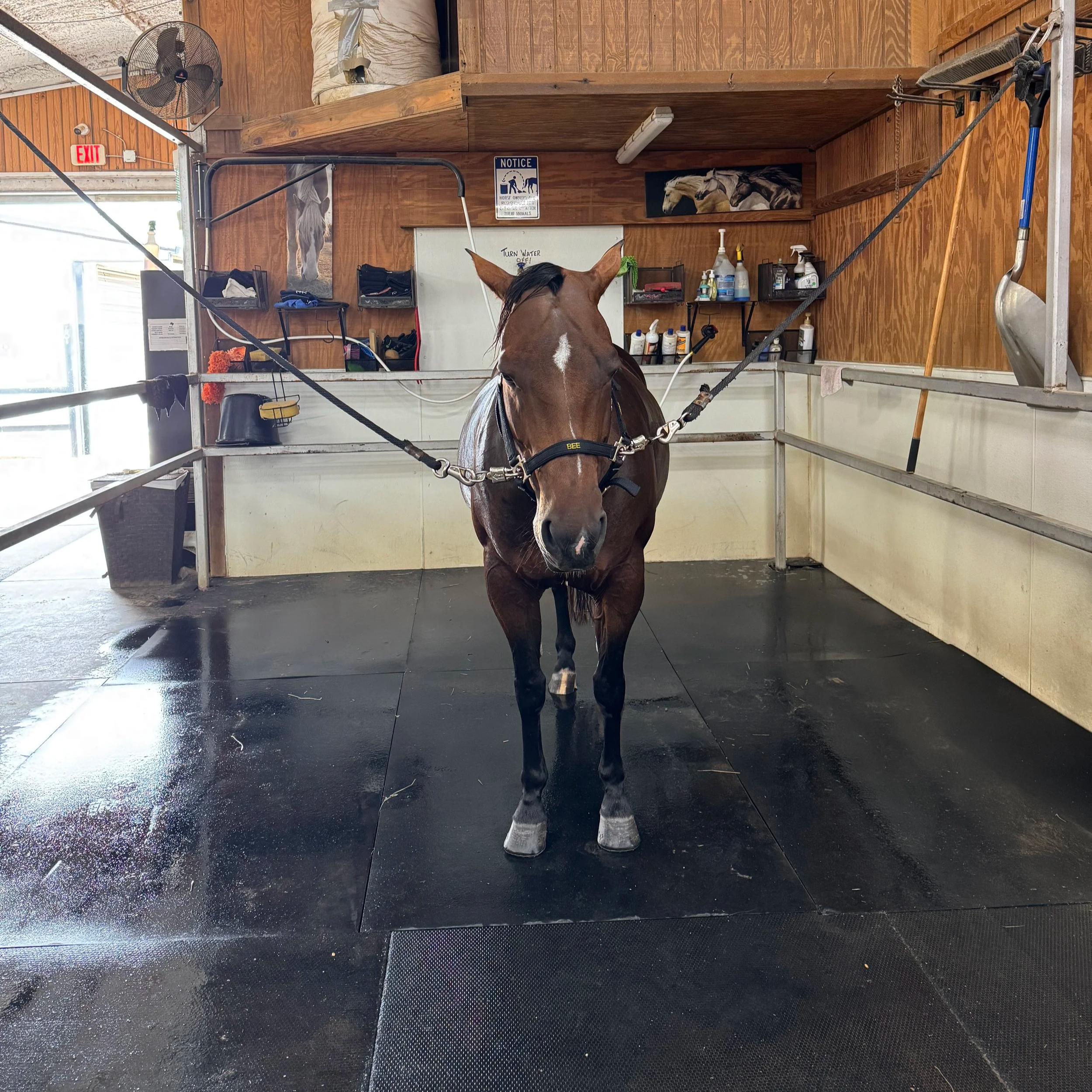
Bee in the cross ties. Give us a caption for this picture. Who does her forelock remind you of?
There's also an important little piece of hardware that I didn't know anything about before owning a horse. Bee's cross ties have a panic snap, or quick-release snap, where they connect to her halter. I'll include a close-up because it's one of those pieces of horse equipment that makes perfect sense once somebody shows you what it does.
The snap is designed so the connection can be released if a horse panics and pulls back. Cross-tie setups can also incorporate other breakaway features, depending on the barn. The point is that you don't want a frightened 1,000-pound animal trapped and fighting against an unyielding restraint. Penn State specifically recommends quick-release snaps and/or breakaway components as safety features for cross ties.
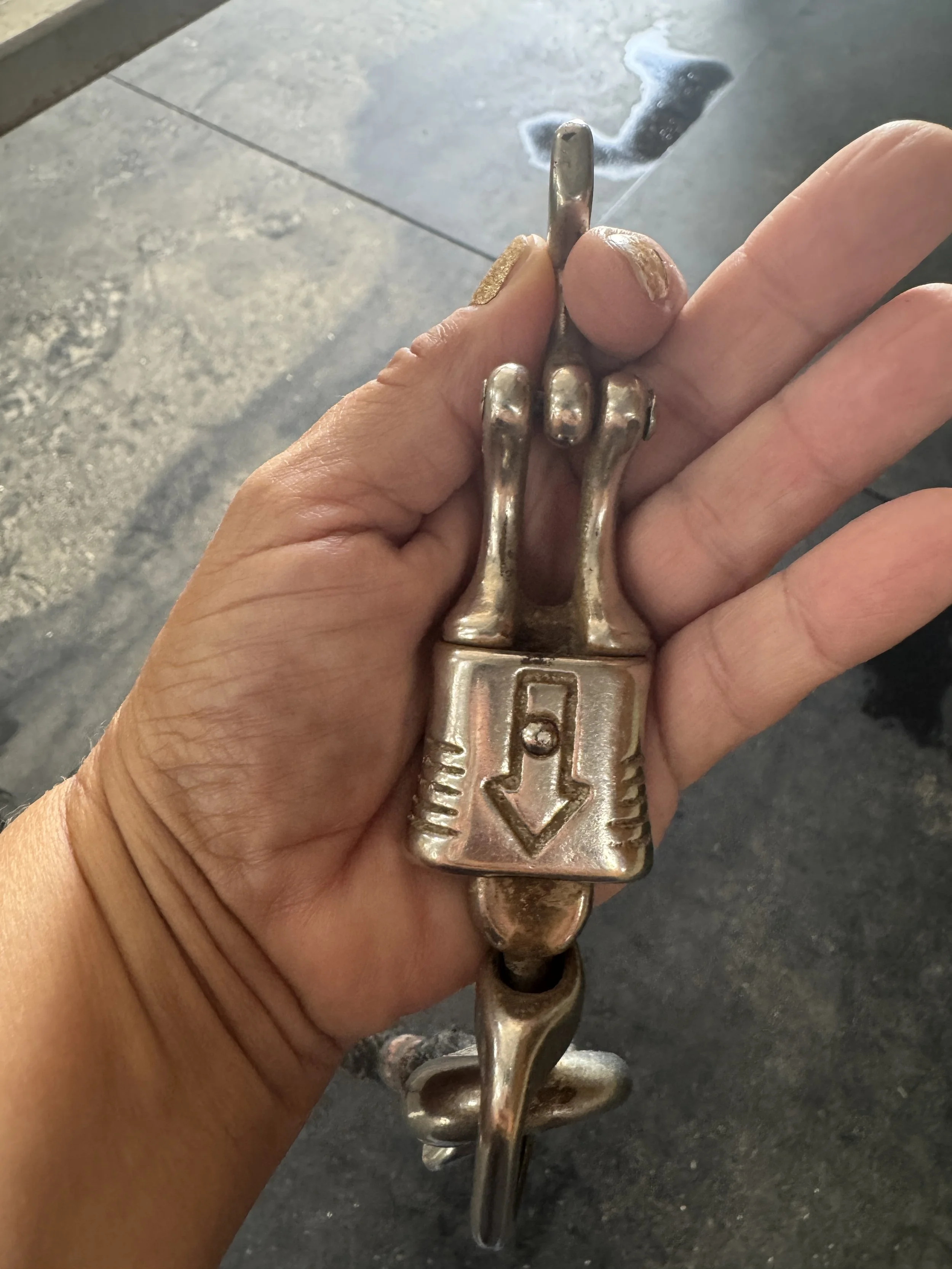
Panic snap: The quick-release mechanism connecting Bee's cross tie to her halter provides a way to release the restraint in an emergency. Thanking God I have not had to use it for an emergency.
Now Turn on the Hose
One of the first things I learned about hosing Bee was to start at her feet and lower legs and gradually work my way up. If you hang around barns long enough, you'll hear various explanations about why you absolutely MUST start at the feet. The practical lesson for me is much simpler: don't surprise a horse by suddenly blasting cold water onto her back (although our barn is so boujee we have cold AND hot water).
I start low, give Bee a chance to adjust to the water and then gradually work my way up her legs and onto the rest of her body. As I move around her, I'm also paying attention to where I am standing. Horses have blind spots directly in front and behind them, so basic handling guidance recommends working alongside the horse rather than parking yourself directly behind her.
For an actual bath, rather than our normal post-ride rinse, I want to get into all the places where sweat and grime accumulate: legs, shoulders, hindquarters, belly, between the front legs, around the girth or cinch area, underneath the mane, and eventually the neck and head. A rubber grooming mitt or curry can help work shampoo through the coat and loosen dirt.
And that brings us to one of Bee's newest discoveries.
Apparently the Nubby Gloves Are a Massage
Somewhere along the way, I found a pair of those rubbery grooming gloves covered in little nubs at the wash bay. I thought they'd make scrubbing easier and remove more dirt than my hands alone.
Bee apparently believes I purchased equine massage equipment.
When I use them on her belly, she stretches her neck forward and down and starts making the most ridiculous faces. Her lips move, her nose wiggles and she looks as though she's entered another dimension. I'm not entirely sure whether it tickles, scratches an itch she can't reach or is approaching something considerably more inappropriate for a family-friendly horse blog.
Whatever is happening, the lady likes it.
Horses naturally groom one another, and many enjoy scratching or rubbing in preferred areas, so grooming can be more than simply removing dirt. It's also another opportunity to pay attention to what your horse enjoys and what makes her uncomfortable. Not every horse enjoys the same pressure, tool or location, so Bee's bizarre facial expressions are actually useful feedback.
In her case, the feedback is pretty clear: keep scrubbing.
Shampoo, Conditioner and Horse Hair
Bee only gets what I consider a real bath a few times a year. By real bath, I mean we're breaking out the shampoo, soap, conditioner and the whole production. That's very different from rinsing her with water after a sweaty ride, which happens daily during a North Texas summer or after a workout.
When we do the full spa treatment, shampoo gets worked through the coat and then rinsed extremely well. That's important because soap left behind can irritate skin. The tail deserves particular attention because shampoo residue left around the dock, the fleshy upper portion where the tail hairs originate, can make a horse itchy enough to rub and damage the hair.
Conditioning the mane and tail isn't just about making a show horse look fabulous, either. Bee isn't headed into a halter class, but I still want to protect that hair. Long mane and tail hairs can break when they're dry, tangled or aggressively brushed. Conditioner or detangler adds slip, making knots easier to separate without ripping through them. Grooming guidance recommends carefully separating tangles with your fingers and working small sections rather than dragging a comb through one giant knot.
I had a lot of practice brushing hair in a way that wouldn’t hurt with our three girls and I use the same technique on Bee. You don't grab the top of a horse's tail with a brush and yank your way toward the bottom like you're late for work. I work through smaller sections and start at the ends, gradually moving upward as the tangles release. It takes longer, but every long tail hair you rip out is a hair that has to grow back.
And then there are the fairy knots.
Wait. What Are Fairy Knots?
Fairy knots are those maddening little knots that seemingly appear in a horse's mane overnight. You carefully detangle everything, come back the next day and somehow a tiny section has twisted itself into a knot while nobody was looking.
Horse folklore, naturally, came up with a much better explanation than wind, rolling, rubbing and tangled hair. For centuries, mysterious tangles in horses' manes have been associated with fairies, elves or other nighttime visitors supposedly knotting the hair, sometimes because they'd been riding the horses during the night.
Obviously, I prefer that explanation.
In the considerably less magical world of grooming, the goal is to keep those knots from becoming larger tangles. Conditioner or detangler helps, but patience matters more. I work them apart with my fingers rather than attacking them with a brush and sacrificing half the mane in the process.
If the fairies insist on continuing to visit Bee in the evenings, I'd appreciate it if they'd start bringing conditioner.
Then We Reach the Face
This is where Bee and I have historically disagreed.
She has never liked having her upper neck or face washed. She moves away and thrashes her head, so for a long time I didn't wash those areas as thoroughly as the rest of her (if at all).
Then necessity changed our routine.
Bee started developing what appeared to be a fungal-type skin issue on her forehead, face and around her ears. I began regularly washing those areas with baby soap and, just as importantly, drying them thoroughly with a towel. The skin problem resolved quickly.
I want to be careful here because I didn't have the condition diagnosed, so I'm not suggesting baby soap is a treatment for a fungal infection or that someone should copy what worked for Bee instead of calling a veterinarian about a persistent skin problem. What it taught me was that sweat, dirt and lingering moisture deserve attention. Good hygiene and grooming are important to skin health, while persistently damp conditions can contribute to certain equine skin problems.
So now, if Bee's face gets sweaty during a ride, I wash it. I'm certainly not throwing shade at people who don't routinely wash their horses' faces. This is simply what I've decided works for Bee.
And here's what I've discovered: she actually likes most of it.
Apparently This Is a Facial Now
Bee loves having me gently scrub around the outside of her ears with a brush and baby soap. She likes the sides of her face, her forehead and underneath her chin. The horse who previously informed me that her head was a restricted-access area will now stand there and thoroughly enjoy much of the spa treatment.
Then comes the rinse.
And we thrash about a bit.
Less than we used to, mind you. Progress! But she still tosses her head enough to preserve the tradition. At this point, I think some of it may simply be for posterity.
I'm careful around her eyes and don't spray water directly into her ears. On sensitive areas, gentle handling, a soft brush, sponge or cloth gives you much more control than blasting away with the hose.
Then I bring out the towel.
Suddenly, I own a different horse.
When I start drying the inside of Bee's ears, she practically melts into my hands. Her head lowers, the resistance disappears and she turns to mush while I rub them dry. Apparently water near the ears is highly questionable, but a vigorous towel massage afterward is five-star service.
Horses. Consistency has always been part of the deal.
Rinse Means RINSE
Whether I'm washing Bee's body, mane or tail, once I've used shampoo I need to get it back out. Thorough rinsing matters, particularly in places where suds can hide, such as underneath the mane, around the tail dock, belly and between the legs. Professional bathing guidance recommends continuing until all signs of shampoo and suds are gone.
That's another difference between a bath and a quick rinse after riding. When I've added products, I'm responsible for removing them again.
Then we get to another piece of horse equipment that I had no clue how to use when I started.
What the Heck Is a Sweat Scraper?
Once Bee has been rinsed and we're ready to remove the excess water, I reach for a sweat scraper.
Despite its slightly alarming name, I'm not scraping Bee's skin. It's essentially a horse-sized squeegee. You run the smooth rubber or curved edge along the coat with gentle pressure, following the contours of the body, and it pushes excess water away.
There are a couple different styles because apparently even removing water from a horse requires equipment choices.
Sweat scrapers come in different shapes and materials, but the basic job is the same: use the smooth edge to remove excess water from the coat.
I don't use one on Bee's face or other sensitive areas. That's towel territory. (And by the way, does your barn provide clean towels at the wash rack, asking for a friend, because mine does!)
There's also an important distinction between drying a comfortable wet horse and actively cooling a hot horse after exercise. This is an area where some old barn advice has changed. Current research supports continuously applying cool water to a hot horse rather than repeatedly stopping to scrape the water away. Penn State recommends thoroughly wetting the entire horse and continuing to apply cool water for five to 15 minutes when rapid cooling is needed; research has found that repeatedly scraping between applications doesn't improve cooling and can actually slow it.
So if Bee is hot, my first priority isn't getting her dry. It's getting her cool.
Once she's comfortable and we're finished actively cooling, then I can scrape excess water, towel her face and ears and start the drying process.
A Rinse Isn't the Same as a Bath
This is probably worth emphasizing because when horse people say, "I bathed my horse," we may be describing completely different things.
During our hot Texas summers, Bee gets rinsed frequently after exercise. That's primarily water to remove sweat and help her cool down. If her face is sweaty, I wash that too.
A full bath is another production altogether. That's when shampoo, conditioner and the rest of the beauty salon come out. Bee gets those only a few times a year. I don't need her squeaky-clean every day, and regular grooming does much of the everyday work of removing dirt, loose hair and debris. Routine grooming is an important part of maintaining healthy skin and coat even if your horse will never set foot in a show ring.
The same goes for mane and tail care. I'm not conditioning Bee's hair because she needs to win a beauty contest. I'm doing it because I want her mane and tail clean, manageable and protected from unnecessary breakage.
She's allowed to look fabulous while we're at it.
Drying Is Part of the Bath
For Bee, bath time doesn't end when I turn off the hose.
I'll scrape the areas where a scraper makes sense, towel her head and ears, and make sure the areas I've intentionally washed are drying well. I'm particularly conscious of this now because of the skin problem we dealt with around her face. Keeping a horse clean matters, but keeping chronically damp skin clean and dry matters too.
And because Bee lives a considerably more luxurious life than she acknowledges, she may then stand in front of the Portacooler while she finishes drying.
The pump is out this week on “her” Portacooler. Terrible accommodations. She's filing a complaint with ASPCA.
Bath Time Has Become Another Lesson
Bathing a horse sounded pretty simple before I owned one. Now I know about cross ties and panic snaps. I know why I pay attention to where I'm standing and where the hose is. I know the difference between rinsing a sweaty horse and giving her a full bath. I've learned how to use a sweat scraper, why I don't rip a brush through her tail, why conditioner isn't reserved for show horses, and apparently that tiny fairies sneak into barns at night specifically to mess with everyone's manes.
But Bee has taught me something else through all of this.
Bath time is another opportunity to work on trust and handling.
The face she once barely wanted me to wash is now the face she lets me scrub, rinse with slightly less theatrical protest, and towel dry until she practically melts into my hands. Had I simply decided, "Bee doesn't like having her face washed, so I won't do it," I never would have discovered all the parts of it that she actually enjoys.
Progress doesn't necessarily mean she has to love everything I ask her to do. Sometimes it's standing a little quieter than yesterday. Sometimes it's one less head toss. Sometimes it's learning that something uncomfortable isn't dangerous. And sometimes it's discovering that the horse who spent months telling you not to mess with her head actually wants you to scrub around her ears a little harder.
I'm learning to listen to what Bee is telling me without necessarily letting her cast the deciding vote.
Except for the nubby gloves.
On that issue, the vote was unanimous.
Sorry we don’t have more pics or vids this week, I’m on stall rest……