
Halloween was weeks ago. The decorations are coming down, Thanksgiving was yesterday, and I thought spooky season was officially behind us.
Apparently, nobody told Bee.
This week, my sweet, sensitive, occasionally fire-breathing dragon decided that miniature Highland cows, a leaf blower, a bicycle, and a mail truck were all potential threats to our continued existence.
And just to keep things interesting, the cooler temperatures seem to have given every mare at the barn a renewed appreciation for speed.
It's been quite a week.
The Great Highland Cow Conspiracy
Earlier this week, Bee and I headed out for a ride toward the hay pasture (this was after having worked pretty hard in the arena). The weather was lovely, and everything was going beautifully.
Until it wasn't.
Along the road, across the street, live some miniature Highland cows. If you've never seen one, picture the cutest little shaggy cows with fabulous bangs and faces that look like stuffed animals.
They're absolutely adorable.
Unless you're Bee.
According to her, these tiny, fluffy creatures were clearly plotting our demise.
She spotted them and wanted to bolt.
I held her where we were and asked her to back up, giving her a familiar task to focus on instead of running away. Then I decided my feet would be much more useful on the ground.
We walked back and forth along the fence line while the cows happily grazed, completely oblivious to the crisis unfolding across the road.
I asked Bee to move her feet around me, change direction, and pay attention to what I was asking. We continued until her snorting and heavy breathing began to subside.
Progress!
And then came the leaf blower.
Another perfectly ordinary object that apparently required Bee's immediate attention.
Her head shot up, and she went on high alert.
Or should I say Bee on alert?
Sorry. Couldn't resist.
We worked our way toward the sound, repeating familiar groundwork exercises at a distance she could handle. Eventually, her breathing slowed, her head returned to a more normal position, and she began blinking again.
For my non-horse friends, these are some of the signs I watch for when Bee is beginning to relax. A horse's breathing, posture, eyes, and overall responsiveness can tell us quite a bit about how they're feeling.
Finally, we were walking back past the cows, who remained entirely uninterested in us.
Everything was fine.
Until a bicycle came whizzing past from behind.
Bee lost her damn mind.
She jumped sideways, and I wasn't quite prepared for it.
Mind you, bicycles have passed us a million times without incident. But apparently, on this particular day, the bicycle was a horse-eating monster.
Thankfully, I had hold of her rein, and she wasn't going anywhere. But it startled both of us, and we needed another opportunity to regroup.
Once she settled, we continued toward the back of the hay pasture, where I got back on.
And do you know what happened?
Absolutely nothing.
We walked flat-footed all the way back to the barn. No rushing. No funny business. No attempts to hurry home.
She wasn't even barn sour, which is a term horse people use when a horse becomes anxious or eager to return to the barn and its companions.
In fact, when we reached the barn, I asked her to walk right past it.
And she did.
No argument. No drama. Just a lovely, relaxed walk.
After everything we'd encountered, I considered that a pretty successful outing.
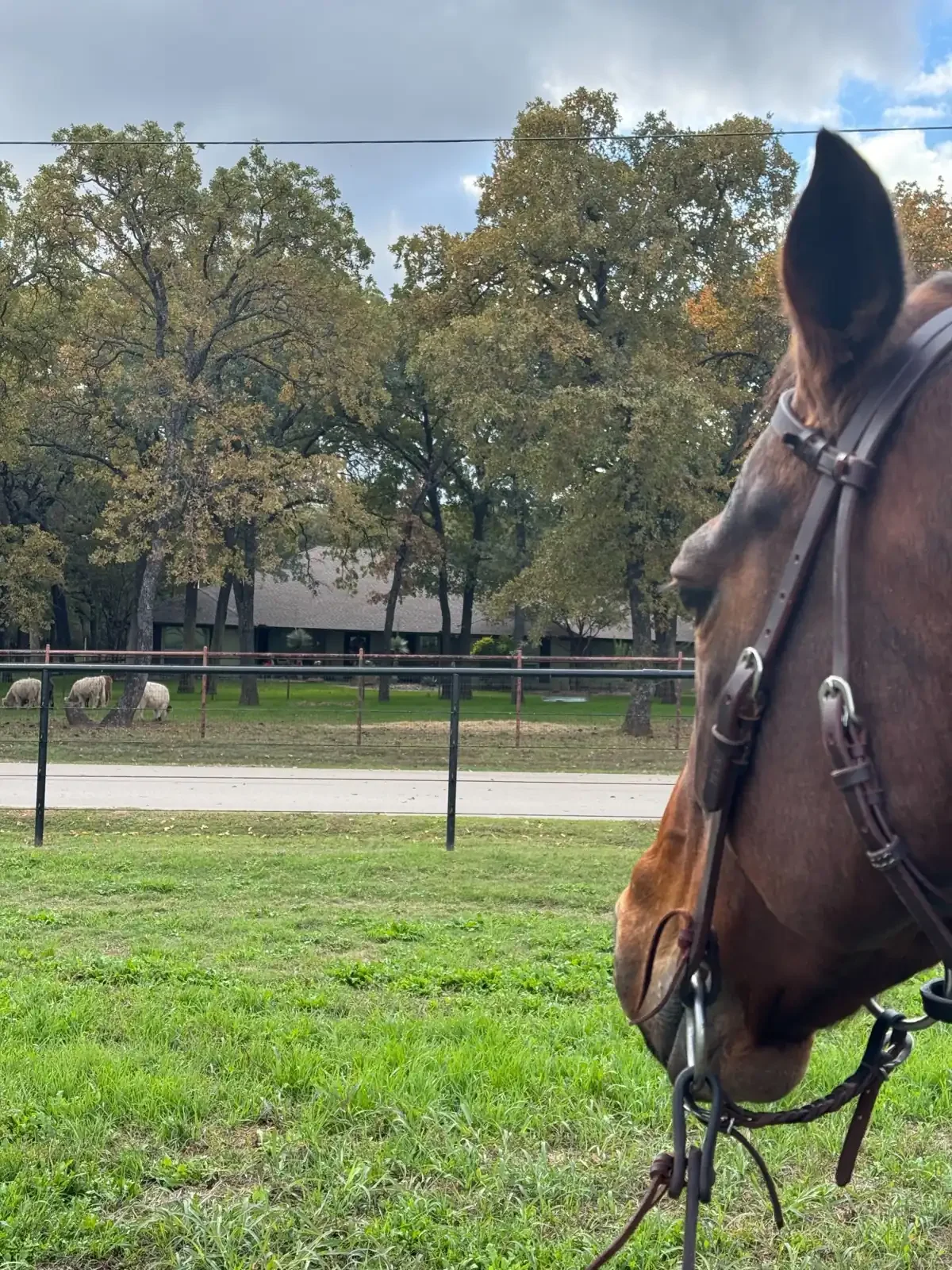
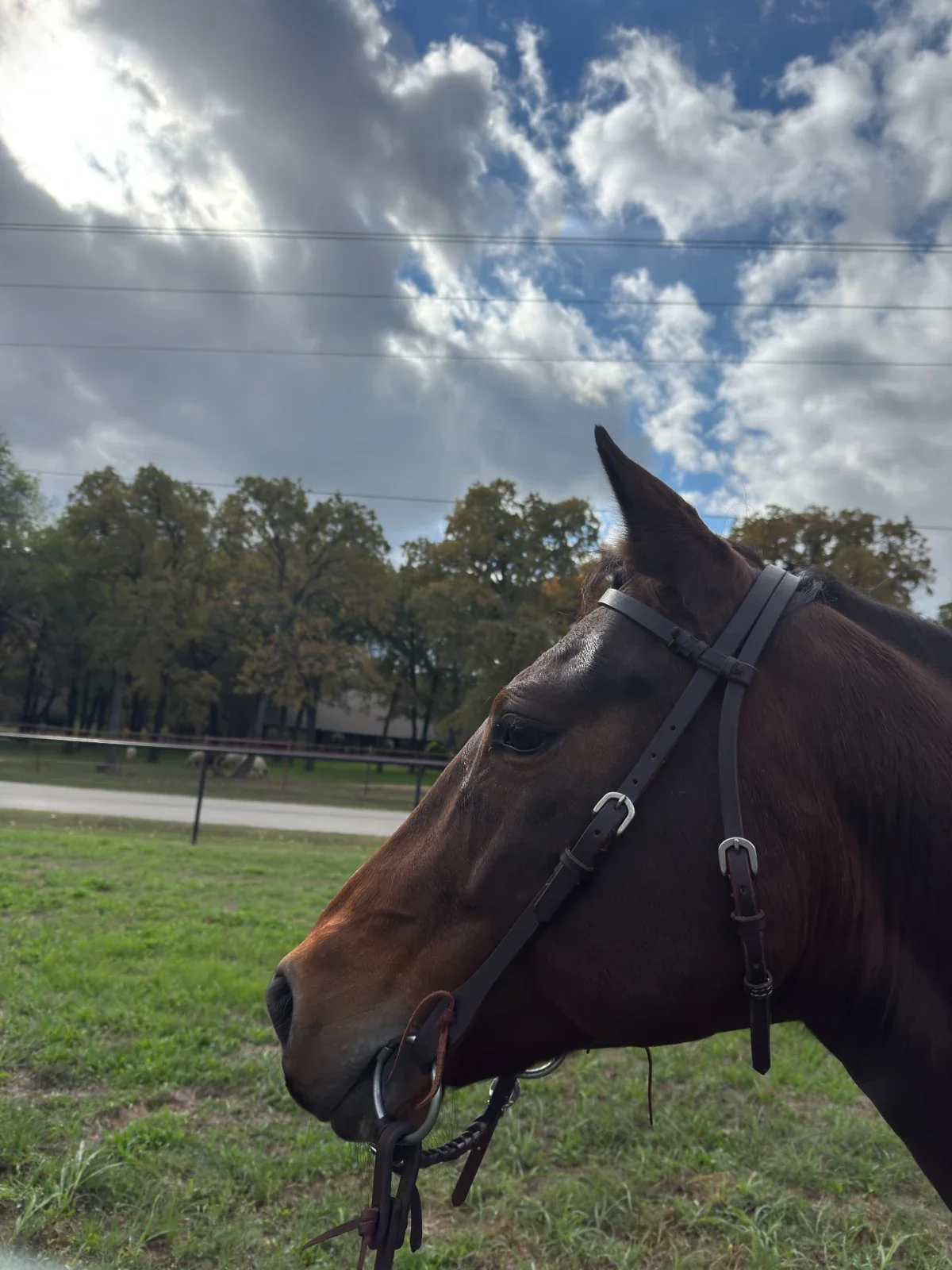
From High Alert to Happily Relaxed
A horse's breathing, posture, eyes, and overall responsiveness can tell us quite a bit about how they're feeling.
Notice the difference in Bee's expression and ear position in these two photographs. While ear position alone doesn't tell us everything about a horse's emotional state, combining it with breathing, muscle tension, head position, and overall responsiveness can help us recognize when a horse is becoming more comfortable.
Why Can Familiar Things Suddenly Become Scary?
Here's something that can be frustrating about horses: Just because they've seen something a hundred times doesn't mean they'll react the same way the hundred-and-first time.
Take the bicycle.
Bee has encountered bicycles countless times. But this one approached from behind, unexpectedly, after she'd already been unsettled by the cows and leaf blower.
Horses are prey animals. Their survival instincts are designed to detect possible threats and react quickly, sometimes before they've had a chance to figure out whether the danger is real.
They also don't always generalize experiences the way we expect. A bicycle approaching from the front may be an entirely different experience from one suddenly appearing behind them.
There's also something called trigger stacking.
It's the idea that several stressful or exciting events close together can leave an animal increasingly reactive. Even when the first frightening thing is gone, the horse may not have fully returned to a relaxed state before the next surprise arrives.
The cows weren't dangerous. Neither was the leaf blower or bicycle.
But Bee's nervous system didn't necessarily see it that way.
That's why I try to pay attention to her breathing, posture, and ability to respond to familiar cues rather than simply assuming she's fine because we've moved past whatever frightened her.
And it's also why I chose to work through those situations from the ground.
The goal isn't to force her to confront something terrifying. It's to help her regain enough confidence and focus that she can process what's happening without feeling the need to flee.
There's also the matter of self-preservation. Jim has already informed me that if I'm going to have a catastrophic riding accident, it needs to be the life-ending variety. He's apparently better prepared for widowhood than a career in nursing.
Meanwhile, the Mares Were Feeling Fabulous
The following day, a barn mate captured a video of the mares running around their pasture like they'd all received an invitation to the Kentucky Derby.
Tails flying. Legs everywhere. Not a care in the world.
They were clearly feeling themselves.
Perhaps the funniest part of this video was a conversation I had with another mare mom afterward.
"I was impressed Arielle came in fourth place," she said.
I laughed because I, too, had been mentally calculating where Bee placed in the race.
What does that make us? Competitive?
In a barn full of women, I suppose it was inevitable. Apparently, we can't even watch our horses enjoy their free time without turning it into a sporting event.
The biggest surprise, however, was Mai Mai leading the charge. If we'd placed bets before the race, I suspect most of us would have picked her to come in dead last.
Mai Mai is relatively low in the proverbial herd hierarchy, while Bee tends to fall somewhere in the middle of the pack.
Interestingly, a horse's position in the herd hierarchy doesn't necessarily dictate who initiates movement or leads the group during play. Social rank often has more to do with priority access to resources, such as food, water, and preferred resting spots, than who's out in front during a spontaneous pasture race.
Apparently, Mai Mai has been keeping her athletic abilities a secret.
And here we thought the mares were just getting some exercise. Little did they know their mothers were analyzing race results.
Thank goodness nobody had money riding on it.
And with the cooler temperatures arriving in North Texas, I can't say I was particularly surprised.
Horse people often describe this behavior as being fresh.
But why do horses sometimes become so energetic when the temperatures drop?
For starters, horses generate a lot of heat when they exercise. Cooler temperatures can make running and playing more comfortable, especially after a long, hot Texas summer.
Changes in turnout, feeding, and exercise routines can also influence energy levels.
And horses are social animals. When one horse starts running, others often join in. Sometimes it's a response to something in their environment, and sometimes it appears to be pure enthusiasm.
Watching the mares, I'd say enthusiasm was winning.
Of course, cooler weather doesn't automatically make every horse behave differently. Temperament, fitness, routine, and environment all play a role.
But after watching that pasture performance, I probably should have suspected that Bee might have a little extra pep in her step.
The mares were feeling themselves in the cooler weather. Apparently, somebody forgot to tell them they're not racehorses.
And Then the Mail Truck Slammed Its Door
Today, we were riding in the arena.
Everything was going fine.
Until a mail truck slammed its door.
That was all it took.
Bee bolted forward.
No warning. No discussion. No opportunity for me to prepare for what was coming.
Apparently, she interpreted the sound as the starting gun at Churchill Downs.
One second we were peacefully walking along, and the next my approximately 1,000-pound horse (although perhaps a little less these days, and I'm sure she'd appreciate my acknowledging that) decided we needed to leave the scene immediately.
Watching the video, it probably doesn't look particularly dramatic.
But there's a significant difference between watching a horse suddenly accelerate and sitting on that horse when you weren't anticipating it.
I wasn't prepared, and it jarred me.
Thankfully, I managed to bring us to a stop. We both needed a moment for our heart rates to return to something resembling normal.
And just when I thought we could regroup and continue our ride, the other horses left the arena.
Bee was not pleased.
After collecting ourselves, I asked her to trot.
She decided to lope.
For my non-horse friends, a lope is a controlled, three-beat gait, essentially a slower canter. It's faster than a trot and perfectly lovely when you've actually asked for it.
I had not.
Apparently, we were no longer taking requests.
I brought her to a stop again, backed her fat dragon ass up, and promptly exited the vehicle.
Time for some groundwork.
I put Bee on the lunge line and asked her to move around me, increasing and decreasing her speed.
Bee had opinions about this arrangement, too.
When I asked her to pick up the pace, she threw in a few bucks for good measure.
My dragon was feeling herself.
And apparently, I was expected to appreciate the performance.
It may not look dramatic, but my heart rate tells a different story.
Fresh, Frightened, or Just Full of Herself?
Here's where horse behavior gets interesting.
A horse who's feeling fresh isn't necessarily frightened. And a frightened horse isn't necessarily misbehaving.
Sometimes those behaviors overlap.
A horse might be energetic because the weather feels wonderful, then genuinely spook at an unexpected sound. Afterward, that same horse may remain tense, distracted, or more reactive than usual.
When a horse spooks, its flight response can take several forms. Some horses jump sideways. Others spin, freeze, or bolt forward.
Bee demonstrated two different versions this week: a sideways jump when the bicycle startled her and a forward bolt when the mail truck door slammed.
Neither was particularly enjoyable from my perspective.
And after the arena spook, Bee had another factor to consider: her friends had left.
Horses are herd animals, and separation from their companions can create additional anxiety or frustration. That may have contributed to her decision to lope when I asked for a trot.
Was she still unsettled from the mail truck? Possibly.
Was she feeling energetic from the cooler weather? Could be.
Was she annoyed that everyone else got to leave while she was still working?
Knowing Bee, I have my suspicions.
But we can't know exactly what she was thinking.
Even the bucking during lunging doesn't necessarily mean she was deliberately refusing to cooperate. Excitement, tension, frustration, or discomfort can all contribute to that behavior.
The important distinction is that fear and excitement aren't the same as intentional disobedience.
Sometimes the Smartest Move Is Getting Off
One thing Bee continues to teach me is that riding isn't about proving how brave you are.
It's about making good decisions for both you and your horse.
During our hay-pasture adventure, I chose to dismount when she became increasingly concerned about the cows. We worked through several challenges from the ground, and eventually I felt comfortable getting back on.
We finished with a quiet, relaxed ride home.
During our arena ride, I got off after the unexpected bolt and the unrequested lope because I no longer felt confident continuing from the saddle.
Both decisions were about safety.
Groundwork can be useful for helping a horse return its attention to familiar cues, but it shouldn't become punishment for being frightened. (If I’m honest, I may have had a little thought of punishment for being such a dragon.) Nor is lunging simply about running the energy out of a horse. Pushing a frightened or overly excited horse harder can sometimes make matters worse.
The goal is communication, responsiveness, and relaxation.
And sometimes the best decision is to end the session and try again another day.
There is no trophy for staying aboard when you no longer feel safe.
I Thought Spooky Season Was Over
This week, Bee reminded me that progress with horses is rarely a straight line.
One day, we successfully navigated miniature Highland cows, a leaf blower, and a surprise bicycle, then enjoyed a perfectly relaxed ride back to the barn.
The next day, the mares were celebrating cooler temperatures with their own version of the Kentucky Derby.
And today, a mail truck slammed its door, and my dragon apparently decided she'd been entered in the race herself.
Same horse. Same rider. Very different experiences.
But here's what I'm learning: Confidence doesn't mean never being scared. It means recognizing what's happening, making thoughtful decisions, and knowing when to change your approach. I’m not going to lie, getting off is a tough decision, I’m frustrated that I don’t have the confidence that I can sit through anything.
And perhaps most importantly, remembering that the horse underneath you is a living, thinking, feeling animal, not a machine programmed to behave the same way every day.
As for Bee, I'm hoping next week brings fewer imaginary predators.
Although I'm not making any promises.
We haven't encountered the garbage truck lately.
Until next time, keep your heels down, your sense of humor intact, and your seat belt fastened.
Love,
Bee's slightly rattled human
*P.S. Bee sure to watch the videos! First, the mares enjoying their cold-weather