
February 13, 2026: Needles, Teeth, and Medieval Equipment
This week’s Buzz is brought to you by annual exams, vaccinations, and one very thorough dental visit. I’ll let Mom handle most of the explaining, but Bee would like it noted up front that she tolerated the entire experience very well. Mostly because she was sedated. Highly recommend.
First things first, Bee’s annual exam began with vaccinations, handled by Dr. Doebecka and her right hand, Sydney, an efficient two-woman team who make the whole process look seamless. Dr. Dobecka owns Restoration Ranch Veterinary Wellness. She specializes in Chiropractic, Acupuncture, Shock Wave, Pulsed Electro Magnetic Field Therapy and Traditional Veterinary Therapies. During Vet School at A&M (Gig ‘Em!) Dr. Dobecka had the opportunity to train at Dubai Equine Hospital, one of the world’s premiere equine facilities. What I love about Dr. Dobecka is that she takes the time to educate owners so we can provide the best healthcare and lifestyle possible for our horses. Sydney, who is currently working on her Master’s in Social Work while assisting Dr. Dobecka, administered the injections with calm confidence while Bee stood there pretending she was above it all.
These vaccines are given intramuscularly, typically in the neck muscle. No sedation needed. Bee is no stranger to needles anyway, since I give her a weekly injection of Altrenogest to help keep her mare hormones in check. So while she may have opinions about many things, needles are not high on her drama list.
She received Fluvac Innovator, which protects against equine influenza and rhinopneumonitis (EHV-1 and EHV-4). Influenza spreads quickly anywhere horses gather, and rhino can cause respiratory illness, neurological disease, and even pregnancy loss in broodmares. (For more information on EHV see this Weekly Buzz from November 21, 2025: When the Hat Comes Off — And Biosecurity Goes On.) She also received her core vaccines: Rabies, which is fatal and transmissible to humans; Tetanus Toxoid, which protects against toxins from bacteria commonly found in soil and manure that can enter through even small wounds; West Nile Virus, a mosquito-borne disease that affects the nervous system; and Eastern and Western Equine Encephalomyelitis (EEE and WEE), both mosquito-transmitted viruses with high fatality rates that cause severe neurological damage.
After vaccinations, it’s normal to monitor for mild soreness at the injection site, slight stiffness, or low-grade fever. Most horses handle them beautifully, but we always keep an eye out for swelling or unusual reactions. Many veterinarians recommend giving horses a lighter day or even a day off after vaccinations, especially if they seem sore, because their immune system is actively responding. Bee would like it noted that she supports this policy fully and believes all vaccine days should automatically qualify as spa days.
Needles may not be glamorous, but prevention is far easier, safer, and far less expensive than treating any of those diseases down the road.
Have you heard the myth that a horse’s teeth grow forever? Horses do not technically have teeth that “grow forever,” but they do continuously erupt throughout most of their lives. Horses evolved to graze many hours a day, grinding fibrous plants, which naturally wears teeth down. To compensate, their teeth slowly erupt to replace what’s worn away. The problem is that modern horses don’t eat exactly like their ancestors, and their teeth don’t always wear evenly.
That’s where dental exams and floating come in.
Dr. Doebecka began Bee’s dental exam by sedating her so she could fully relax. Dental work in horses requires precision, and sedation keeps everyone safe and stress-free. Once Bee was comfortable, Dr. Dobecka rinsed the mouth and placed a speculum to gently hold her mouth open. Even sedated, the speculum looks like it came straight out of a medieval torture chamber. There’s no other way to describe it. Functional, necessary, and slightly horrifying to anyone seeing it for the first time.
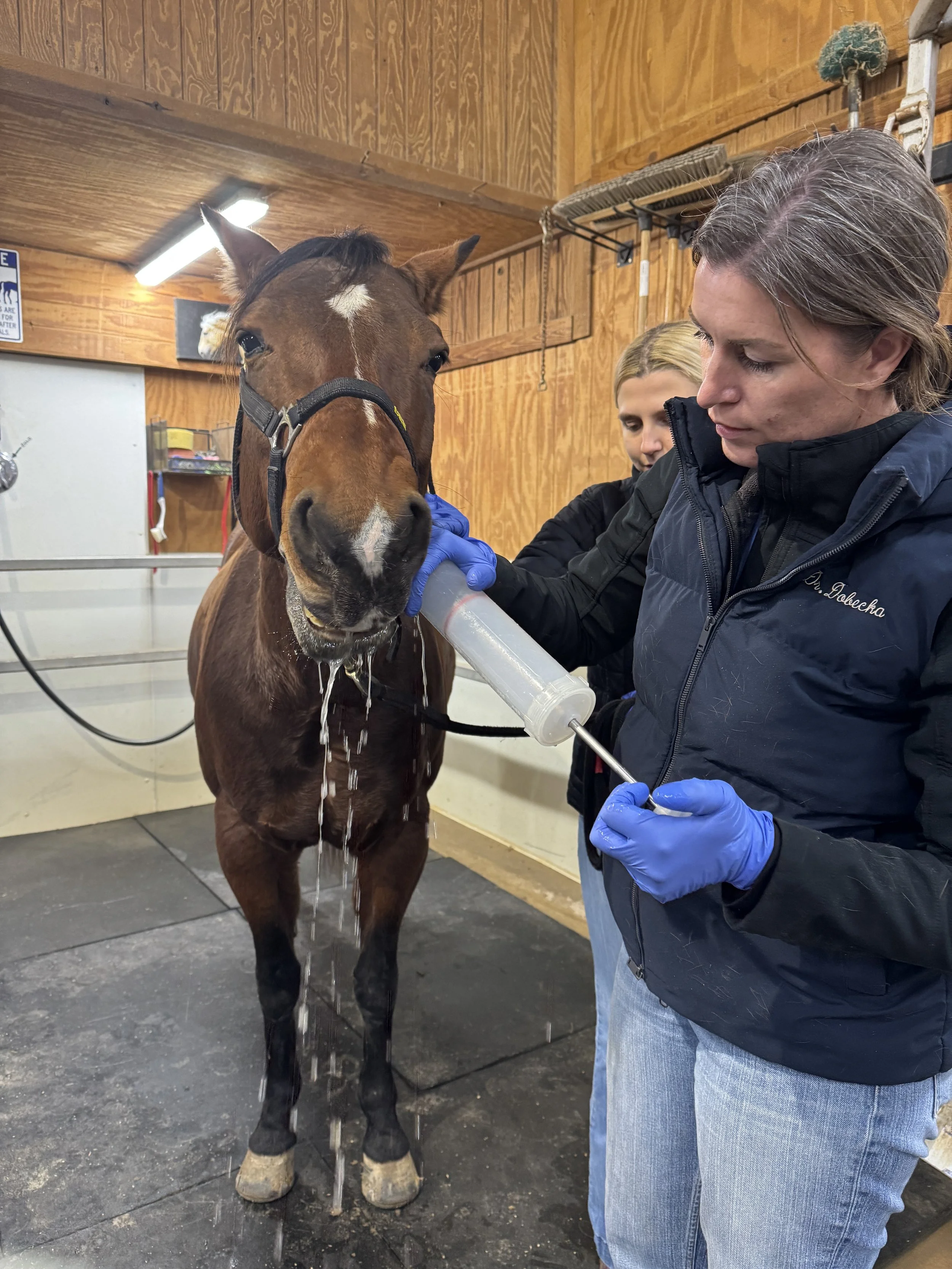
A little pre-dental post-sedation flush of the mouth. Mind empty. Mouth clean.
Dr Dobecka inserts and opens the speculum with the assistance of Sydney. Who has the tougher job? My vote is Sydney!
Sydney holds Bee’s head up, because drugs, while Dr Dobecka shows me Bee’s sharp teeth.
With Bee’s mouth safely open, Dr. Dobecka carefully examined each tooth, checking for sharp points, hooks, waves, fractures, and any signs of infection or abnormal wear. Horses’ teeth don’t wear evenly because their upper jaw is wider than their lower jaw. This causes sharp enamel points to form on the outside of the upper teeth and the inside of the lower teeth, especially toward the back of the mouth where hay grinding happens most.
Bee had some pretty sharp points in the back, which told us she was definitely due for a float. Left untreated, those sharp edges can cause pain, ulcers inside the cheeks or tongue, resistance under saddle, head tossing, trouble chewing, weight loss, and even behavioral changes that look like “attitude” (as if we need more of that) but are really discomfort.
Dr. Dobecka used a specialized dental drill to gently file those sharp points down, restoring a more even grinding surface so Bee can chew comfortably and move her jaw freely. And yes, at one point Mom realized that “Milwaukee” makes horse tools. Because apparently power tools truly do rule the world.
Despite needing the work, Bee overall fared very well. No missing teeth, no infections, no major abnormalities. Just routine maintenance that will make her more comfortable and healthier going forward.
After the dental, Bee stayed sedated for a bit to allow everything to settle. Dr. Dobecka’s helper, Sydney, who is also a fellow boarder at Equine Obsession, generously offered her horse, Niko’s, stall so Bee could hang out safely while the meds wore off. Bee accepted this hospitality graciously, mostly because she was still feeling very relaxed about life.
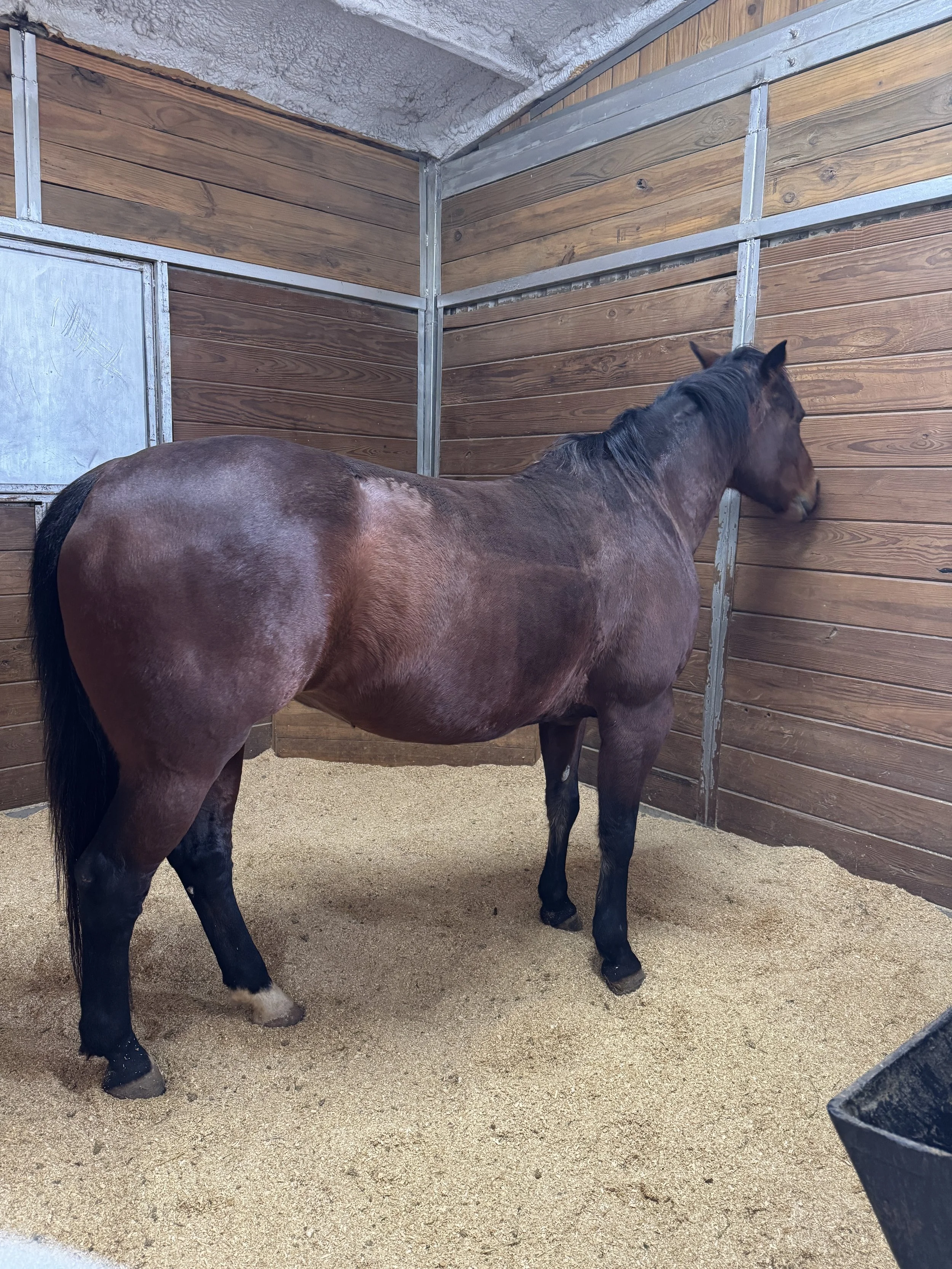
Post-dental Bee. Lights on. Nobody home.
Dental care is one of those things that’s easy to overlook because problems aren’t always obvious. Horses can’t tell us their mouth hurts, and they’re very good at compensating. Regular dental exams help prevent issues before they turn into pain, poor performance, or bigger health concerns.
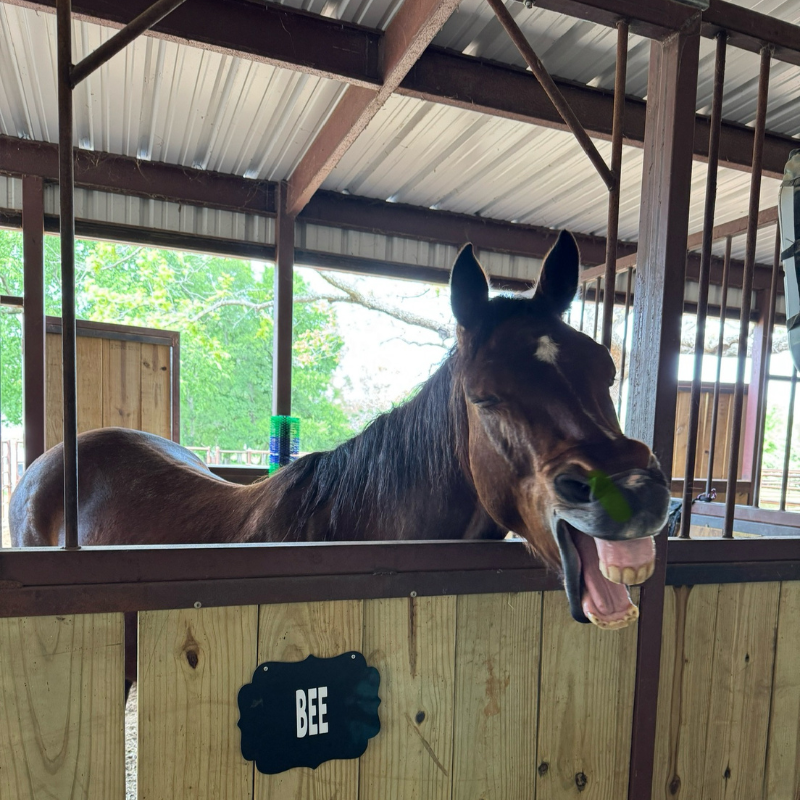
🐴🦷 Barn Sidebar: Why Horse Teeth Shaped Our Language
Since we’re already talking about teeth, here’s a little history lesson you didn’t know you needed.
“Long in the tooth” comes directly from how horses age. Horses’ teeth continuously erupt throughout much of their lives to compensate for wear from grazing. As teeth wear down and gums gradually recede, more of the tooth becomes visible, making older horses appear to have longer teeth. The phrase dates back to the 1600s and eventually became a polite way of saying someone is getting older.
“Don’t look a gift horse in the mouth” is just as literal. Historically, one of the fastest ways to estimate a horse’s age and overall value was to examine its teeth. If someone gifted you a horse and you immediately pulled back its lips to inspect its mouth, you were essentially questioning the value of the gift. The phrase reminds us to accept generosity without picking it apart.
Before modern veterinary diagnostics, teeth were one of the most reliable indicators of age. Horse traders evaluated eruption patterns of the incisors, the disappearance of “cups,” the angle of the bite, and even a feature called Galvayne’s groove to estimate age surprisingly well. Still happens today!
Horse teeth have been influencing deals, decisions, and everyday language for centuries.
Annual exams like this aren’t glamorous. There are needles. There are weird tools. There is drool. But they’re a huge part of responsible horse ownership and long-term soundness.
Bee is now vaccinated, dewormed, dentally refreshed, and back to eating hay without sharp surprises. She would like everyone to know she survived, she was brave, and she looked extremely cute afterward.
Until next week,
Mom (with a mildly sedated but very cooperative Bee supervising) 🐴