
September 11, 2026: Grazing Muzzles, Hay Nets & Bee’s Diet Plan
Bee has gained some weight since coming home from Sarah's, and I can identify at least two culprits.
The first one is me.
Sarah can put considerably more work on Bee than I do. I ride her and keep her moving, but I'm under no illusion that my workouts rival professional training. Apparently standing at the mounting block discussing how pretty she is does not count as cardio.
The second culprit is her pasture. And this one surprised me.
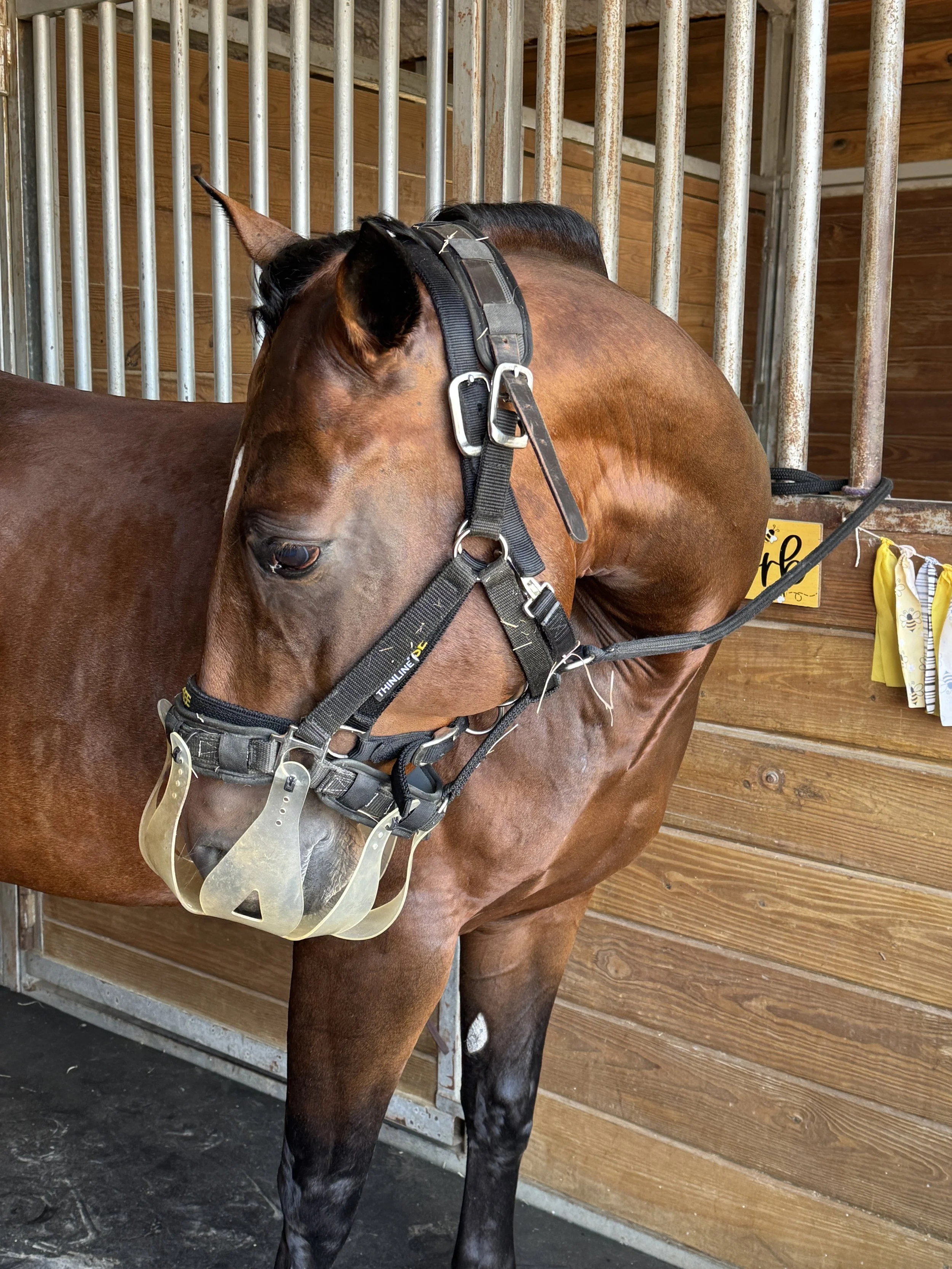
So, for the past few weeks, Bee has added two new accessories to her wardrobe: a ThinLine grazing muzzle and a Schneiders Corner Slow Feeder with the smallest openings.
Neither, much to Bee's disappointment, is decorative.
Dead Grass Doesn't Necessarily Mean Diet Grass
This was one of those horse-owner lessons I didn't fully understand at first. You look at a brown, tired Texas pasture and think, There can't possibly be any nutrition left in that.
Unfortunately, Bee did not get that memo.
Pasture grass contains carbohydrates, including sugars, and the amount can change depending on the type of grass, weather, season and whether the plant is actively growing or under stress. A pasture that looks dry or less nutritious can still contribute calories, and stressed grass can sometimes contain more sugar than you might expect.
That matters for more than Bee's waistline. Excess weight can contribute to metabolic problems, and horses with insulin dysregulation are at increased risk of pasture-associated laminitis, a painful and potentially serious condition affecting the structures that support the hoof. High intake of nonstructural carbohydrates from pasture can be a trigger in susceptible horses.
You'll sometimes hear laminitis referred to as founder, although technically founder generally describes the more advanced changes that can occur inside the hoof as a result of laminitis.
So I'm learning not to judge Bee's buffet by how appetizing it looks to me.
The pasture may look dead.
Bee sees an all-night Golden Corral.
Enter the Grazing Muzzle
That's where Bee's ThinLine Flexible Filly grazing muzzle comes in.
I'll admit, I wasn't thrilled about putting a muzzle on my horse. I knew why we needed one, but Bee spends her turnout time in a pasture with other horses, fences, gates and all the other things horses somehow manage to get themselves tangled up in. If she was going to wear something on her head for hours at a time, safety mattered as much to me as limiting how much grass she could eat.
That's a big reason I chose the ThinLine system.
I bought the muzzle, their turnout halter and the recommended zip ties directly from ThinLine. The halter has a leather breakaway crown, and the muzzle attaches with special zip ties that are actually designed to break under enough pressure. ThinLine says those ties are rated to release at about 55 pounds and will typically give way first. The flexible muzzle itself provides another potential break point, followed by the breakaway portion of the halter. In other words, if Bee gets the muzzle caught on something, parts of the system are intentionally designed to fail rather than stay attached at all costs.
That's one of those times when having something “break” would actually be exactly what I wanted it to do.
Of course, breakaway equipment doesn't mean there's zero risk. Horses are remarkably talented at finding trouble no product designer ever imagined. We still check Bee, her equipment and her pasture regularly. ThinLine also recommends checking that a horse can drink properly in the muzzle before leaving them turned out in it.
Right now, Bee is stalled during the hot daytime hours and turned out with the mares at night. She wears her muzzle during nighttime turnout so she can stay outside, move around with her friends, drink and graze, while limiting how much grass she can actually consume.
That's important to me too. I don't want weight management to mean taking away turnout or separating her from her herd. Although the other mares may be looking at her with that head gear on and taking a few steps away.
Bee figured out the muzzle remarkably quickly. Eating? Check. Drinking? Check. Finding every possible blade of grass that can fit through that little opening? Obviously.
Her official review:
⭐☆☆☆☆
Would prefer unrestricted buffet.
And During the Day, We Slow Down the Hay
While Bee is in her stall during the day, her Coastal hay and alfalfa go into a Schneiders Corner Slow Feeder with the smallest openings.
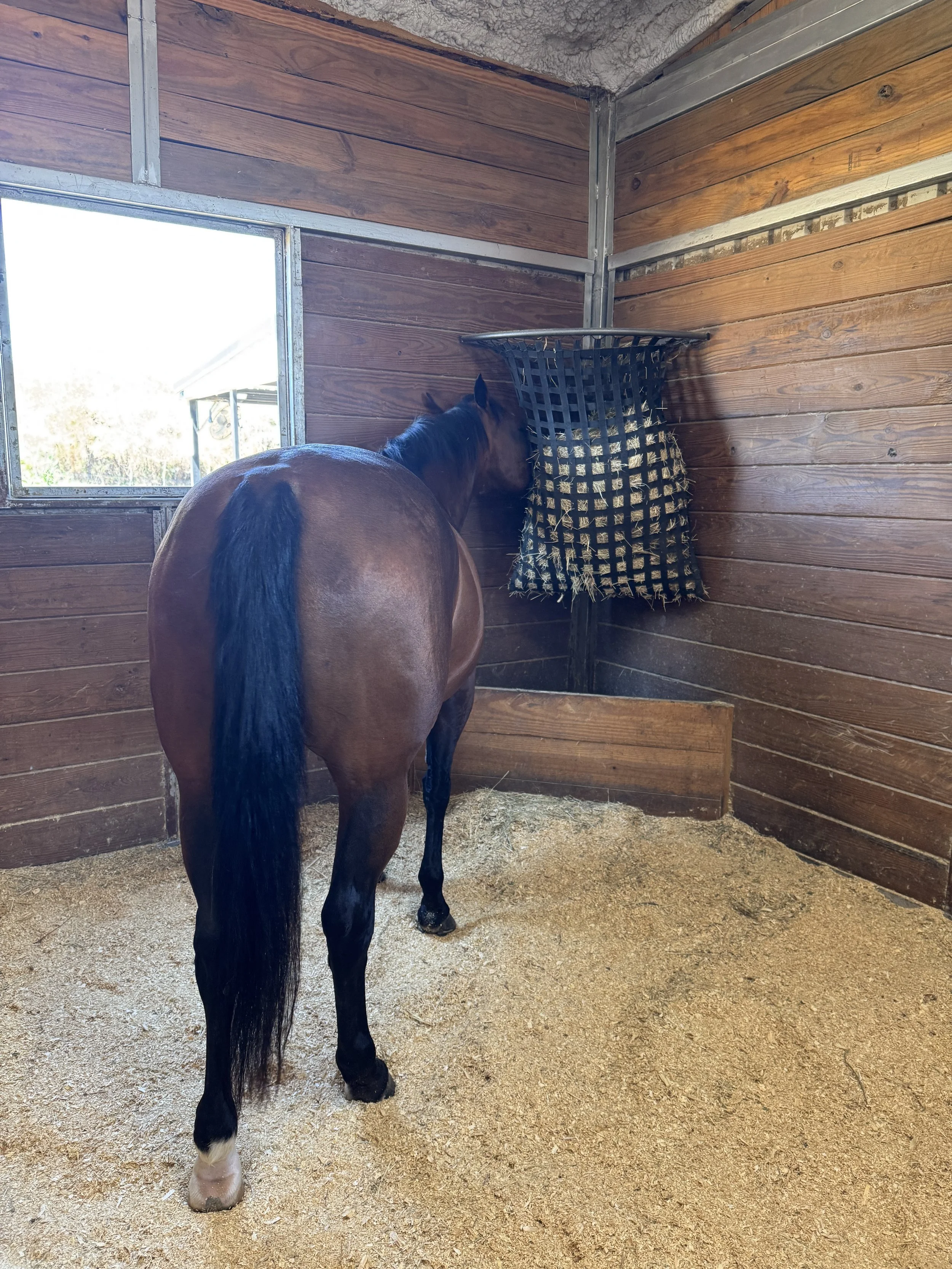
The alfalfa was not placed front and center according to Bee's specifications, so she took matters into her own hooves eating from back to front.
I'd used a traditional slow-feed hay net with Bee before, so I already knew she understood how to eat from one. But when I was looking for something to use every day in her stall, I also wanted to make life easier for the guys feeding her.
Traditional slow-feed nets can be a bit of a production. You have to unlatch or untie them, open them, awkwardly wrestle the hay inside, close them and hang them back up. That's manageable when you're feeding one horse. When you're feeding an entire barn, I'm pretty sure no one wants Bee's diet plan adding another five-minute project to morning chores.
The Schneiders feeder stays hanging in place and is open at the top, so the guys can simply drop her hay into it. We positioned it directly over Bee's hay bin, too, so the pieces she pulls through and drops don't end up scattered across her stall. They fall into the bin where she can still eat them.
At least, that was the beautifully efficient plan.
We failed to account for the fact that Bee has opinions about food presentation.
Bee gets both Coastal hay and alfalfa, and she would prefer the alfalfa to be placed front and center, thank you very much, where it can be accessed with minimal effort. The guys haven't quite figured out her preferred buffet arrangement yet.
So occasionally I find her doing what you see in this week's photo: sticking her head behind the entire slow feeder in an attempt to access the alfalfa from the other side.
Apparently, slow feeder does not mean accept the order in which your food has been presented.
The nutritional idea behind the feeder is still a good one. Instead of grabbing large mouthfuls of hay and finishing quickly, Bee has to pull smaller amounts through the openings. That stretches her forage over a longer period and more closely resembles the way horses naturally spend much of their day eating small amounts of forage.
Basically, we haven't taken away lunch.
We've turned it into an escape room.
Bee has simply discovered the secret passage.
What's Actually on Bee's Menu?
Bee isn't simply getting “less food.” We're trying to manage how much, how quickly and where her calories are coming from, while still making sure she gets the nutrition she needs.
Her diet includes Coastal hay and alfalfa, along with whatever she's able to graze from the pasture. She and the other horses also have access to a round bale at night, giving them another forage source in addition to pasture.
Bee also gets a small amount of Triple Crown ration balancer.
A ration balancer is one of those horse terms that sounds considerably more complicated than it is. It's a concentrated feed designed to provide important nutrients without requiring the larger serving, and calories, of a traditional grain feed. That's especially useful for horses whose calorie needs are largely being met by forage but who may still need additional protein, vitamins and minerals to balance the overall diet.
So Bee's nutritional program isn't really about deprivation. It's more like portion control combined with making her work harder for every bite.
Which seems unfair until I remember that I'm supposed to be working harder too.
We're Not Looking for a Biggest Loser Transformation
Bee has been on this program for a few weeks now, and we haven't seen dramatic weight loss.
Good.
That's exactly what we want.
Weight loss in horses should be gradual. Simply cutting food dramatically isn't a safe solution because horses still need adequate forage and nutrients, and overly restrictive diets can create additional health problems. Current veterinary guidance generally anticipates weight loss occurring over weeks or months, not days.
We're managing Bee's pasture intake, slowing down her hay consumption and paying attention to her overall body condition.
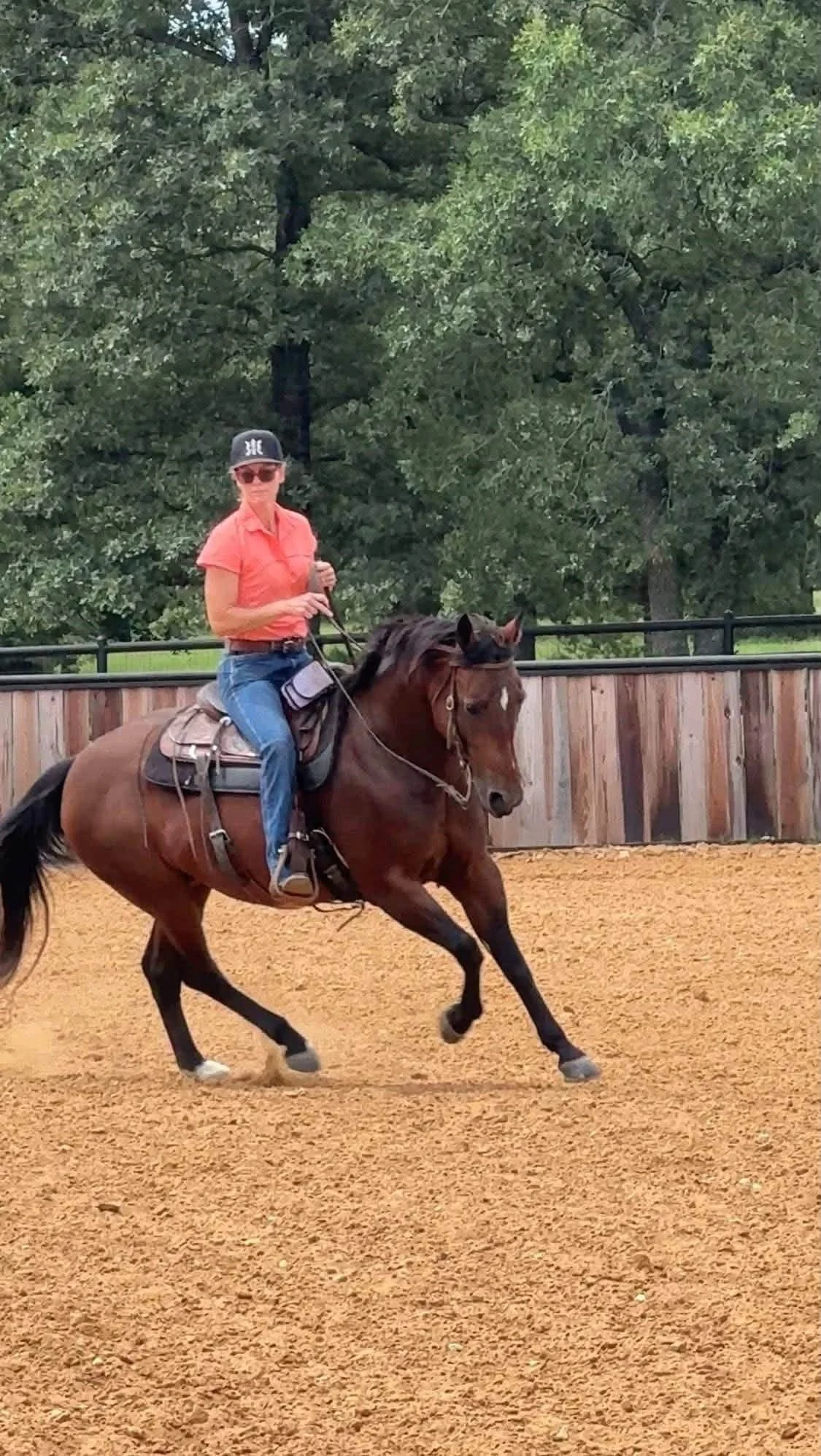
And we're working on the other side of the equation too: exercise.
This is unfortunately where Bee's owner comes in.
Sarah apparently did not send Bee home with a button labeled:
PROFESSIONAL TRAINER WORKOUT
I've checked.
Water, Water and More Water
Then there's water.
We pay particular attention to Bee's water intake during the Texas heat, but hydration matters all year. Adequate water is important for normal digestive function, and making sure horses have free access to fresh water is one of the basic management practices that helps reduce the risk of impaction.
Bee can drink normally while wearing her ThinLine muzzle, which was one of the first things I wanted to make sure she understood.
She also has a salt lick in her stall, and she actually uses it. Horses need salt in their diets, and having salt and fresh water readily available is part of basic equine nutrition and hydration management.
So although we're restricting how quickly Bee can consume calories, we are absolutely not restricting water.
Some things at Bee's buffet remain all-you-can-drink.
Slow and Steady, Bee
This has been another lesson in the balancing act that is horse ownership.
I don't want Bee thin. I don't want her hungry. I don't want her standing around without forage for long stretches. And I certainly don't want to remove her from her herd simply because controlling every bite would be easier in a stall.
I want her healthy.
For now, that means slowing down the hay, limiting the pasture buffet, keeping her moving, watching her body condition and making adjustments gradually.
Bee would undoubtedly prefer a different management philosophy.
Something along the lines of eat more, exercise less.
Which, to be fair, is also the diet and fitness plan I would choose if no one were supervising me.
One More Bee Update
While we're talking about Bee, we've also refreshed her sale ad and made a small adjustment to her asking price. Bee is now offered at $12,500.
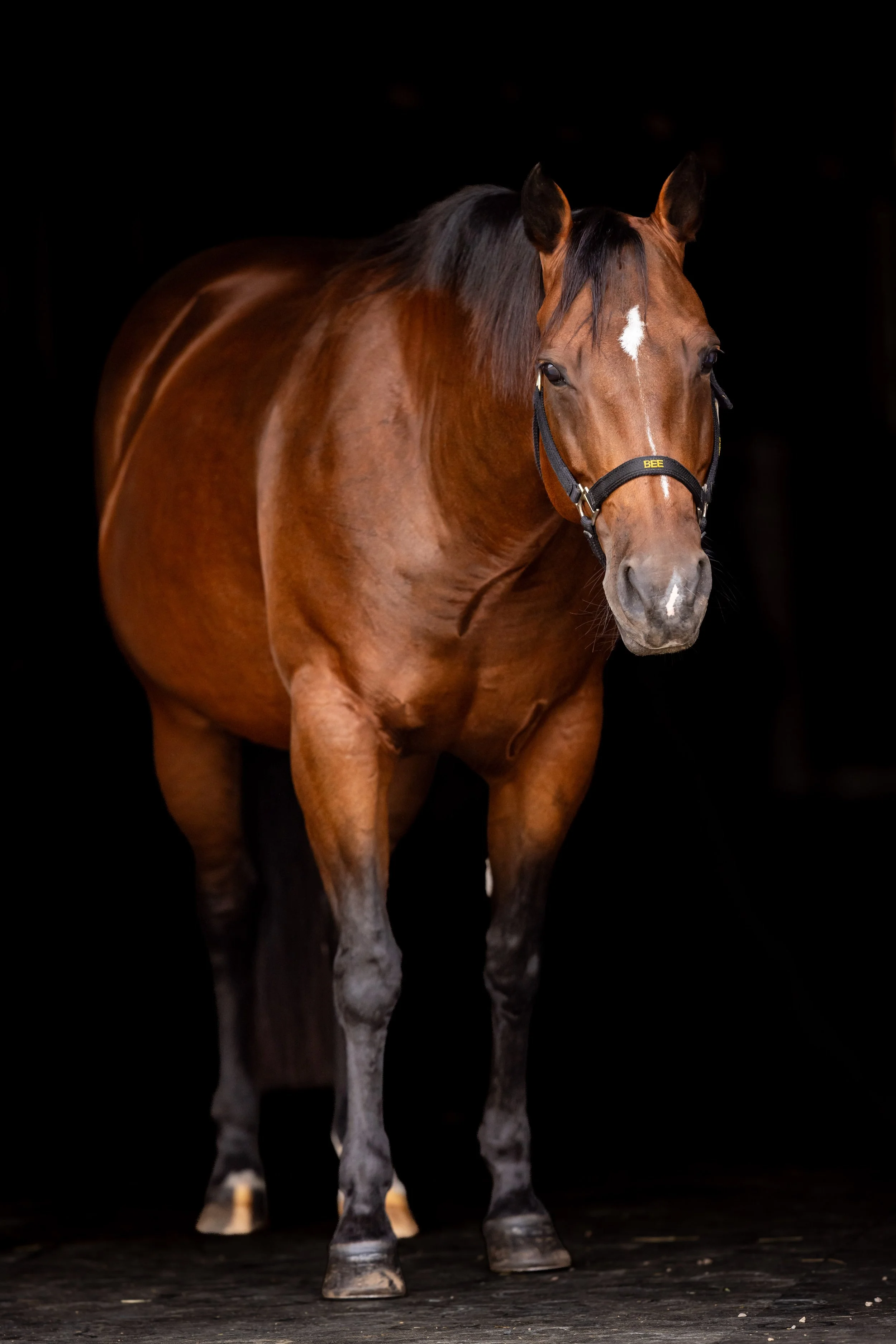
Thank you Abagail Boatright for these amazing pictures of Bee!
Finding Bee's next person has never been about getting her out the door quickly. It's about finding the rider who appreciates the smart, athletic, talented horse she is and is a good fit for all the buttons she comes with.
If you've been following along and think Bee might be that horse for you, you can see her updated information, photos and video here:
And until the right person comes along, she's still here being Bee. She's teaching me, making me laugh, keeping me humble and, for the moment, doing all of it while wearing a muzzle.
I suspect she'd like that last part removed from her sales ad.